100th Post: How I Coach; How You Can Too
How I Coach and My 6 Coaching Zones

2 years ago, I began. I promised to write at least 100 posts. One per week based on my “best of lessons” learned over my career.
That was June 2024. We are now here. July 2026.
My first post began with one of my key philosophies, “Read It; Learn It; Do It; Teach It.”
This 100th post will dive into my coaching practice.
I began my actual coaching practice in late 2019, shortly before Covid. While I had been mentoring and advising for several years prior to that, this time I had a specific client who wanted dedicated 1:1 time. They wanted to pay me for my time. I leaned in.
For full transparency, I’ve never been formally trained as a “coach.” Never been certified with such places like CTI (Coaches Training Institute) or others. I had certainly been exposed to coaches throughout my career so at least I had a mental framework.
I began by interviewing about a half dozen CEO coaches who I respected highly to find out how they did it. After the 6th interview or so, I decided my practice had to be different. To be honest, I continue to have a very difficult relationship with the actual word “coach.” While I completely understood great coaching from a sports context (I belonged to several sports teams as I grew up), business coaches seemed to me to be more theoretical and academic vs practical and operational. Many coaches had never held the actual role of the person they were coaching.
As a CFO coach, I knew I wanted to be different. Having been the CFO “player,” I wanted to make the transition to the “coach” who had been on the field. The person who had been in my client’s shoes, made the mistakes they were about to make, and encouraged them for the successful initiatives they were embarking on.
To be that type of coach, I decided early on I had to know as much about my client as I possibly could as well as critical details of their executive peers, their CEO, and specific board members. To understand all of that, I needed more time. I needed a “Rhythm and a Rigor” with my clients. That means speaking to them at least once every 2 weeks, and ideally every week, so I can stay connected to them and the stories happening inside their companies and their departments.
A few years ago, I took this concept even further, and I began offering “Quick Hits” - quick texts and/or phone calls in the moment when my clients needed somebody like me vs. making them wait for their next “session” in a week or two. By then, their problem would likely have gone stale.
“Always On” coaching became a thing for my clients, as we used these “Quick Hits” to weave in the longer term leadership and career roadmapping that my weekly or bi-weekly deep-dive, 1-2 hour sessions focus on. “Solutioning the Now and Architecting the Future.” Hmmm…I like that phrasing. I may have to turn that into it’s own future post!
Consistently, my clients and colleagues would ask me how my practice scales. Fair question since I coach scaling, and I coach my clients and my colleagues to challenge any/all assumptions and especially challenge my ideas, frameworks, and playbooks. I was very transparent, and my answer for a few years was, “I’m not sure how this 1:1 experience with you ‘scales’,” and then gave many reasons why. The conversation would usually conclude with “You should write a book!” to which I’d reply I’ve had friends and colleagues write books and it’s an arduous 12-18 month “process” (besides, I see books as being more “old school” in today’s Instagram, Youtube, and AI world).
By 2024, I decided I could take a step toward scaling. I could definitely write and publish 1 article per week based on my frameworks and playbooks I coach. Maybe someday I could then stitch together several dozen of these publications into some sort of “book” or other. So, I researched the best publishing platform, began to structure my material by “themes,” and I launched my first post in June of 2024. That was 2 years ago.
So here we are on Substack, 100 posts later. Milestone #1 achieved. I now have a better idea of how I’m going to scale this practice and am developing several more “product” offerings, including a better way to access all my “best of” material and how to gather it in small groups to go really deep in a 1:Many vs 1:1 environment…stay tuned!
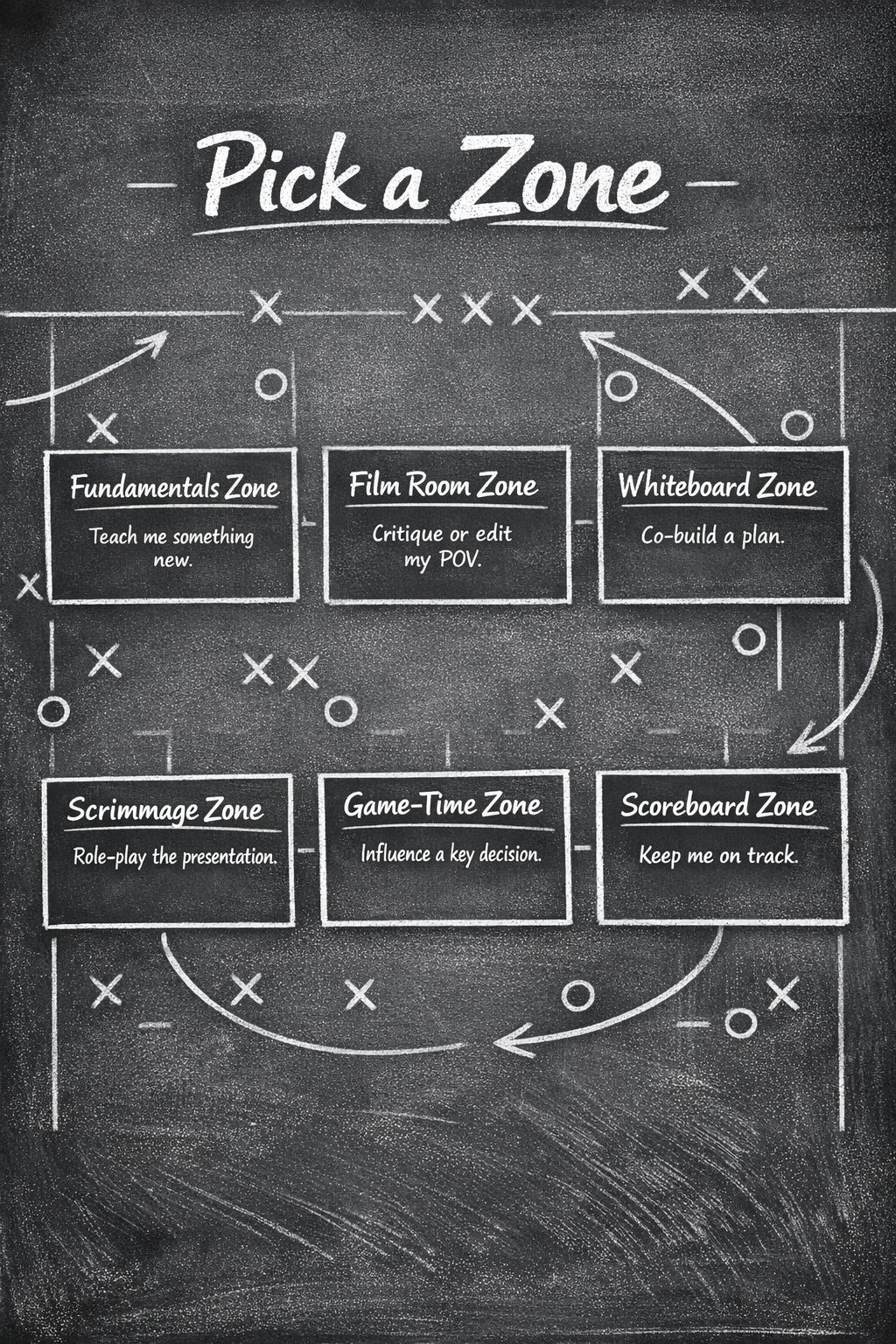
Now, 5+ years into my coaching practice, I continue to pattern match what I have learned about coaching and want to share with you what I believe are 6 “Coaching Zones” that show up in my coaching practice.
The 6 Coaching Zones
Zone 1: “Teach or coach me on something I don’t really know.”
Sports metaphor: Fundamentals + drills.
This is skill-building. The person lacks the mental model, vocabulary, or reps.
My job as coach
Diagnose the gap (knowledge vs. judgment vs. reps)
Teach the concept simply
Give a practice drill and a few ways to self-correct
Definition of done
They can explain it back in their own words
They can apply it to their current situation
They leave with a “next rep” assignment
Powerful questions
“What part is fuzzy: the concept, the steps, or the confidence?”
“Where have you seen this done well before?”
“If you had to teach this to someone else tomorrow, what would you say?”
Zone 2: “I have a point of view - give feedback, critique, or help me edit.”
Sports metaphor: Film room.
This is sharpening, not building from scratch.
My job as coach
Separate signal from noise
Improve the signal (pattern), logic, and structure
Be direct and specific
Definition of done
A tighter argument
A cleaner narrative
Clearer assumptions and implications
Powerful questions
“What do you want the audience to believe after this?”
“What’s the one sentence you’re trying to prove?”
“Where will a skeptic push back first?”
Zone 3: “I have a vision. Can we co-work / draft this together in this session?”
Sports metaphor: Whiteboard + play design.
This is collaborative building. My client has a direction, but needs structure.
My job as coach
Turn rough vision into clear strategy, structure, sequence and playbook execution
Create constraints (scope, time, audience)
Convert “ideas” into an executable plan
Definition of done
A draft, outline, or plan
Clear owners and next steps
A timeline that matches reality
Powerful questions
“What are we solving for - speed, quality, risk reduction, or alignment?”
“What’s in / out of scope?”
“What must be true for this to work?”
Zone 4: “Role play a key presentation.”
Sports metaphor: Scrimmage.
This is rehearsal under pressure. It’s about timing, confidence, and recovery.
My job as coach
Create a realistic simulation
Interrupt with targeted feedback
Run it again until the reps stick
Definition of done
A stronger opening
Cleaner transitions
Better answers to predictable questions
Calmer cadence under heat
Powerful questions
“Where do you feel least confident?”
“What question are you hoping they don’t ask?”
“What’s your one-slide / one-sentence anchor?”
Zone 5: “How do I communicate and influence a critical issue?”
Sports metaphor: Game-day leadership.
This is not about being right. It’s about leading the room to action.
My job as coach
Map stakeholders and incentives
Choose the right channel and sequence
Script the message for the appropriate audience. Define, Align, Decide.
Definition of done
A stakeholder map
A message that matches the audience
A playbook for execution sequencing (who/what first, who/what last)
A strategy for objection handling
Powerful questions
“What do they care about more than your proposal?”
“What’s the cost of doing nothing for them?”
“What’s the smallest ‘yes’ you need first?”
Zone 6 (the one most leaders forget): Execution and accountability, follow-through, behavior change.
Sports metaphor: Conditioning + statistical analysis.
This is where coaching stops being talk and allows everyone to see reality and is the foundation for next session’s feedback and improvement.
Most “coaching” fails here because it’s too detailed. Too hard.
Think of Steph Curry and his 4 hours of shooting practice per day with the computer analyzing his techniques and his outcomes.
Or Scottie Scheffler or Bryson DeChambeau on the driving range with their actual coach analyzing all their swings and outcomes.
My job as coach
Turn game time execution into the next game plan
Push my client for going from good to great
Challenge and fine tune/polish
Definition of done
A scoreboard (what we’ll measure)
A follow-up loop (“when do we review?”)
Powerful questions
“What did you learn?
“What can we improve?”
“How do you want me to hold you accountable to this improvement plan?”
My Coaching Contract (feel free to steal this for your staff 1:1s)
At the start of any 1:1 session, ask:
Which zone are you in today?
What does “good” look like by the end of this conversation?
Do you want high-direct feedback, or more brainstorming?
What’s the next rep… and when do we review it?
This one minute prevents 30 minutes of misalignment.
Coaches Reminder
The goal of coaching isn’t to sound smart.
The goal is to help someone perform better. To hold up a mirror, create more confidence, and establish a clear path from thinking to doing. From good to great.
So next time a client or a direct report shows up with a “can you help me…” request…
Don’t start with answers.
Start with which zone are you in.
More on Picking a Zone: An Example
Most leaders “coach” the same way every time. They default to advice.
But your direct report (or client) isn’t always asking for advice. They’re asking for a specific kind of help. When you mismatch the coaching mode, you create friction:
You teach when they wanted feedback.
You critique when they wanted co-creation.
You talk strategy when they needed reps.
More Powerful Questions To Help Coach
“Do you want Fundamentals?”
“Do you want Film Room Review?
“Do you want Game Planning and Whiteboard/Chalkboarding”?
“Do you want to Scrimmage”
“Or is it Game Time?” (P.S. what did the Scoreboard show after your last game?)
Coaching is a sport.
Sometimes you’re a skills coach.
Sometimes you’re the Offensive Coordinator drawing up plays.
Sometimes you’re the assistant running drills.
Sometimes you’re the head coach managing the clock.
Same coach. Different zone.