


When future historians study the Silicon Valley companies who rewrote the rules of customer value creation, I suspect Netflix will be at the top of the list.
This week’s announcement (Dec 2025) that Netflix is acquiring Warner Brothers Studios is being framed as a bold new chapter where the “Little Red Envelope That Could” is finally becoming a full fledged Hollywood movie studio. It’s like Cinderella. This “movie” is especially poignant to me as I was on the inside in early days… one of the first 6 to start the company. Becoming Warner Bros was always the dream!
And so, I’m going off script this week to promote and reinforce the single most important leadership lesson founders and operators must learn. If you only read my “trailer” quote below it’s all you need to know.
Beyond this trailer, I encourage you to keep reading since “the movie of Netflix” is destined to be an all-time start-up classic with lessons for founding teams that will be looked back upon in history no different than Citizen Kane, Casablanca, How Green Was My Valley, and so many others.
Here’s the “Cook Movie Critic” as I review the “Netflix Movie”.
Trailer:
Winning means doing whatever it takes to deliver a “Wow!” experience for the customer. Especially requiring you to reinvent your business model again and again to exceed your customer expectations as they change and grow.
I and many others have said that every successful company was required to pivot from their original business model. Netflix didn’t pivot just once or twice like most startups do. Netflix pivoted no less than 6 times in its 30 year history. I could say 7 times if you count Qwikster in 2011… but it’s best to just forget that 3 month disastrous pivot attempt and it’s ultimate “Just Kidding”/“Do Over”.
Netflix has been a shining example of following and exceeding the passion of their customers in every single one of these pivots. Few companies have ever been this agile. Netflix deserves a Silicon Valley Lifetime Achievement Award from the “members of the Academy”.
If we are all honest, it’s nearly unbelievable from whoever you ask that this little red envelope company now standing on the precipice of the top of the global entertainment industry today with it’s $83 billion purchase of Warner Bros (though Paramount is trying to valiantly say “My Peak Is Taller”).
In the late 90’s and early 2000’s, Warner Brothers was once the only supporting Hollywood studio in our earliest of days. We depended upon them as a key partner to help create our very earliest customer value. It’s more than ironic that Netflix is continuing to make these shockwaves in this industry that mocked it, copied it, tried to compete with it, and are now saying Netflix will become a monopoly in Hollywood as they all fear becoming the next “Blockbuster Bankruptcy”.
This post is my contribution to go behind the curtain as they say in entertainment land. Once upon a time there used to be an actual TV show called “Behind the Scenes”. It was one of my favorite TV shows as a young adult (I believe it was the late 80s or early 90s?). Maybe this post is tapping into that vibe.
So here’s the 6 specific pivots (Episode / Chapter Style) with the lessons learned from the nearly 30 year history of Netflix pivots and how they’ve arrived at the top of the Hollywood movie studio world.
Episode 1 - The Founding Story - DVDs: The Original Insight
In 1997, the founding team, originally just six of us, made a huge bet against all odds and being told by nearly everyone, “That Will Never Work”. Our big bet? That 480P - 480 lines of resolution that the DVD disc provided - would show movies in a whole new way vs VHS 160P lines of video resolution. The bet was that we could create DVD customers who would want to watch their favorite old movies and potentially collect them (like music CDs) without ever having to go to a physical store (it was the very beginning of the e-commerce boom after all.
While hindsight is always 20/20, it’s important to state that many of you are thinking “of course DVDs.” I can assure you that if Polymarket existed in 1997, this “bet” would be high odds against 4:1? 10:1? I can tell you that all the top VCs of the day passed on us and called us “crazy”. Even after we went public 5 years later with a very small offering designed to simply “survive” and payback our investors, Wall Street cratered our stock by 75% in the first year as they were certain both streaming was coming no later than 2003 and that Blockbuster and the Walmarts and Amazons of the world would win. Wrong, wrong, wrong… again.
But the 6 of us went all in with the same passion as our early customers and designed a “rental system” via the United States Postal System (USPS) - again crazy! Who uses the USPS as their business model?
Bet Big! “Here’s to the Crazy Ones” - Steve Jobs.
Here’s to the crazy ones. The misfits. The rebels. The troublemakers. The round pegs in the square holes. The ones who see things differently. They’re not fond of rules. And they have no respect for the status quo. You can quote them, disagree with them, glorify or vilify them. About the only thing you can’t do is ignore them. Because they change things. They push the human race forward. And while some may see them as the crazy ones, we see genius. Because the people who are crazy enough to think they can change the world, are the ones who do.
We offered an extremely simple vision:
Unlimited choice: We vowed to have every single DVD ever printed and available for other fellow movie buffs. For clear context, at the end of 1998 there were still only 3,000 DVD movie titles ever printed onto that little plastic disc. Supply was limited as there just weren’t that many DVD printers in the industry. Compare that to over 100,000 VHS titles available - and impossible to find at Blockbuster or your mom/pop video store.
Unbelievable Convenience: Delivered to your home. You never have to leave your couch… well, ok, you have to go your home mailbox and back and learn how to work that red flag “thingy” on your box for outgoing mail.
No Late Fees! - The very painful, most negative branding of any brand name company - in this case Blockbuster Video. People literally hated this part of the Blockbuster experience. And “hate” was likely not expressing how people truly felt.
Behind the scenes, however, we weren’t just copying the “old VHS model”. We were building a much deeper and nearly invisible innovation that few understood. Certainly the VCs and Wall Street didn’t get it for several years… except for Redpoint, IVP, and TCV who eventually came in and kept the company alive.
Our innovations included our Disc Inventory Management System; our software brain that matched every customer’s queue with the exact DVD sitting in one of our 60 distributed 5,000-square-foot shipping centers across the country.
Another key innovation was our Recommendation Engine “If You Like This, You May Like That.”
Few realize, we were the 1st Subscription Service as of 1999. Subscription in either e-commerce or software didn’t exist. Salesforce began in 2000 with its then ASP (Application Service Provider). SaaS as a term wouldn’t be coined until around 2005.
Here’s a screenshot from Salesforce in 2000 when they started in earnest. Yes, every company starts this ugly!
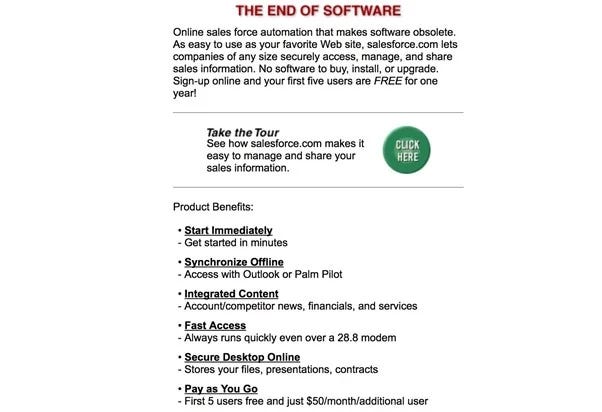
Netflix was the first e-commerce company to create a “future order list”. We invented the concept of the list of the next 10+ movies you wanted to watch, knowing you didn’t want to order them all at once. The whole concept of “Episodes” in your entertainment wouldn’t exist until well after 2010.
Our first operational moat? No, it wasn’t the red envelope. That was simply the operational customer satisfaction vehicle.
Our operational moat was our algorithm of understanding our customers and being “inside their heads” of what they would like to watch next… and then delivering it with a convenient and “wow”-like experience in a cool envelope. What I called then and now our “software inventory management and delivery system”.
Blockbuster and Walmart both eventually tried to copy our entire model but they only did so at the surface layer (the envelope and the picking, packing, shipping). They had no clue of the required software infrastructure to provide the same “Customer Wow” experience.
Culture shapes great companies. Neither Blockbuster nor Walmart cultures fully understood “No Late Fees” and true customer convenience. They tried to copy the Netflix Envelope. They continued to send people to their stores to return the movies. It lasted a few years and eventually Netflix won Chapter 1. Stay tuned…
Episode 2 - Streaming: the Classic Innovator’s Dilemma - Disrupting Your Own Business Before Someone Else Does
In the late 2000’s (around 2008/9), the Netflix team made the courageous decision to begin to cannibalize the physical DVD model - the only revenue engine at the time. Our original dream was always “Now Playing” and to provide internet instant access to our customers but the economic reality required 12+ years post-company founding to not only have “cable internet” - be >50% market share vs “Dial Up” - but also the cost of delivering a standard 4.8 gigabytes of movie goodness over these “wires” was finally less than the picking, packing, and 2-way postage per disc (ahem - I clear my throat - which was still greater than $1.50 per movie in 2010).
By 2010, Netflix customers were still even barely asking for streaming in surveys.
Hint: Customers rarely do.
But the vision was clear: If the customer could press play instantly, they would never go back to waiting for the next disc in the mail.
This 2nd chapter - “Streaming vs Disc” and restructuring the business in service for customer delight would become Netflix’s superpower.
Episode 3 - Original Content: From Licensee to Creator
Here’s a personal historical footnote few people know:
In the early 2000s, Warner Brothers was one of the only studios willing to license us meaningful “backlist” titles - the deep library of films that most studios overlooked but customers loved. They even allowed us to burn our own DVDs in the earliest days from these licensed original movies/content/master tapes.
Without the Warner Bros partnership in the earliest of days, Netflix may never have made it. It’s stunning to me that in 2025 - Netflix is now willing to pay the equivalent of $83B for it’s former partner! This from a company that was saved with a $50M investment from TCV (Jay Hoag) when no other VC would provide funds. This $50M came after Netflix nearly begged Blockbuster Video to buy them for $50M not once…not twice… but 3 strikes and they were out. $50M? $83 Billion. Wow.
Netflix made a huge bet with it’s very first original content series - House of Cards in 2013. By huge bet - this one series… I repeat, one series… cost Netflix $100M+ to produce against its 2012 annual revenue of $3.5B and the company was still not profitable 15 years into it’s history.
Orange Is the New Black came next in their original content pivot for another $100M+ and by 2015, Netflix had borrowed (yes, gone into debt) by $6B to get the cash to continue to make even more original content. Today that annual debt figure to produce original content (a.k.a - be the “movie studio”) is +/- $20B annually.
P.S - the economics of the “Original Content” business model was just as obvious and Wall Street was just as oblivious to its 2 prior pivots. Wall Street left the DVD shipping model for dead in 2004 - it survived until 2024 - and it again said Netflix wouldn’t survive it’s attempt to pivot to streaming. So, again in 2015, Wall Street cratered Netflix stock. Just like in any movie, the hero gets knocked down… almost dead… and rises to even greater powers.
Episode 4 - International: The Brave Decision Few U.S. Companies Make
Most American founders underestimate the complexity and necessity of going global.
Netflix went all in in and decided to expand it’s streaming service in early 2016 with a massive 130+ country launch. Talk about big bets.
Every country required adaptations in content, payments, marketing, and distribution.
But the core Netflix principle never changed… customers worldwide loved movies and entertainment. They just need to serve these customers better than the alternative, the competition, which was movie theaters and TV.
Chapter #5 - Advertising, Live TV & Sports: Meeting Customers Where They Are
Here is the biggest misconception in strategy for any company
“Our business model defines us.”
Wrong.
Your customer defines you.
Customers increasingly wanted more flexible pricing, live moments, global sports, and a full entertainment ecosystem. So Netflix reinvented itself yet again.
Netflix was the poster child of saying they would never do advertising or heaven forbid “ad-supported streaming”… until they did… or were forced to during the 100s of billions of dollars during the “Streaming Wars” from 2017-2022 from the likes of Disney, Amazon, Apple, Hulu, etc, etc.
It didn’t matter that live sports is a one and done event… nobody wants to really rewatch a live sporting event.
But Netflix is now actively competing for live sporting events - since that’s what its customers want.
If it is good for the customer, Netflix figures it out.
Episode 6 - Owning a Studio: Warner Brothers - The Final Piece of Vertical Integration
Which brings us to this month - the Dec 2025 pivot.
By acquiring Warner Brothers Studios, Netflix closes a 25-year strategic loop:
They gain deeper leverage into the Hollywood ecosystem
They can own much more IP outright
They expand their distribution capabilities
They can monetize across new channels (HBO, CNN, Discovery Channel)
All in service to continuing to create the deepest customer “Wow!” in the industry
What looks like a shocking move to the outside world is, to me, the boldest and most authentic Netflix move to date. This move has been nearly 30 years in the making.
My prediction? In the future, don’t be surprised to see Netflix take a chapter out of the Apple Store and to brand Netflix movie theaters worldwide - yes those physical buildings Netflix has been trying to kill.
Don’t be surprised when they pivot again (#7?) to embrace and extend and to complete the entertainment desires of their customers both inside their homes and in new locations outside your homes… wherever you are… wherever you go.
The Lesson for This Generation of Founders & CFOs
If you’re building a company today, especially in Ai, fintech, Robotics, or other, ask yourself:
Are we building for the customer’s future, or our current model?
Are we willing to pivot - really pivot - to deliver a “Wow!” Customer Experience?
Are we designing our operating system for constant reinvention?
Are we falling in love with our product… or our customer?
Netflix’s nearly 30 year story is not a story of technology.
It’s a story of organizational courage and passion. It’s big bets anchored in customer obsession.
That’s why and how Netflix survived… ”Against All Odds” and “Rocky” style… (sorry couldn’t help myself with these corny movie analogies).
Warner Brothers is now joining the family. Blockbuster and others may continue to die along the way.
Netflix “the Movie” in 6 Episodes is why the company may just be remembered as the most agile business model ever created in Silicon Valley.
