


I write a lot about designing and executing decision-making systems. This post goes deep on 2 core aspects of any decision system. It’s worthy of its own post.
Before you continue reading on - I know you came for this week's post, but if last week's piece on the private public company is still sitting with you, come continue the conversation live next Wednesday:

Think of the last bad outcome or result from your team or your company.
Did the conversation go like this?
“We shouldn’t have done that.”
“That was a bad call.”
“Who approved this?”
This is one of the most expensive and worse leadership habits inside a scaling startup.
WHY? Because it teaches your team a dangerous lesson: judge the decision ONLY by the OUTCOME.
WHEN that happens, you don’t get better future decisions, you get worse, safer decisions. Political decisions. Slow decisions. Cover-your-ass decisions.
Today’s playbook is about decision science in our sport called business.
If you can remember one thing about creating your own decision making system it’s my headline to never forget to DIVIDE & CONQUER the decision.
Do this by installing two key decision separations. When you do, you’ll find, like I did, that your decisions as a team are instantly upgraded.
Playbook 1: Separate Decisions from their Outcomes
Playbook 2: Separate Decision Control vs Decision Concern
If you can do those two things consistently, you/your team/your company will operate better under pressure, faster during ambiguity, and you’ll implement a dramatically better decision learning system.
The Key Framework: Treat Decisions Like Bets
Playbook #1: Separate Decisions vs Outcomes
There’s a name for confusing a decision with its outcome: “Resulting”. I first heard this term from Annie Duke (world class poker player) in her brilliant book - Thinking in Bets.
RESULTING is the dangerous and expensive belief that:
A good outcome proves a good decision
A bad outcome proves a bad decision
In real life, outcomes are a messy mix of:
Decision Quality
Execution Quality
Decision Timing
Luck; Randomness
External Events
Competitor Actions
Market Moods/Swings
“Unknown Unknowns”
So if you want a company that learns, you need a new decision culture that constantly reminds your team(s):
We need to separate the Decision from the Outcome »»»»»»»»»»»
AND evaluate each separately.
The Decision / Outcome Matrix (Use this in your next leadership meeting)
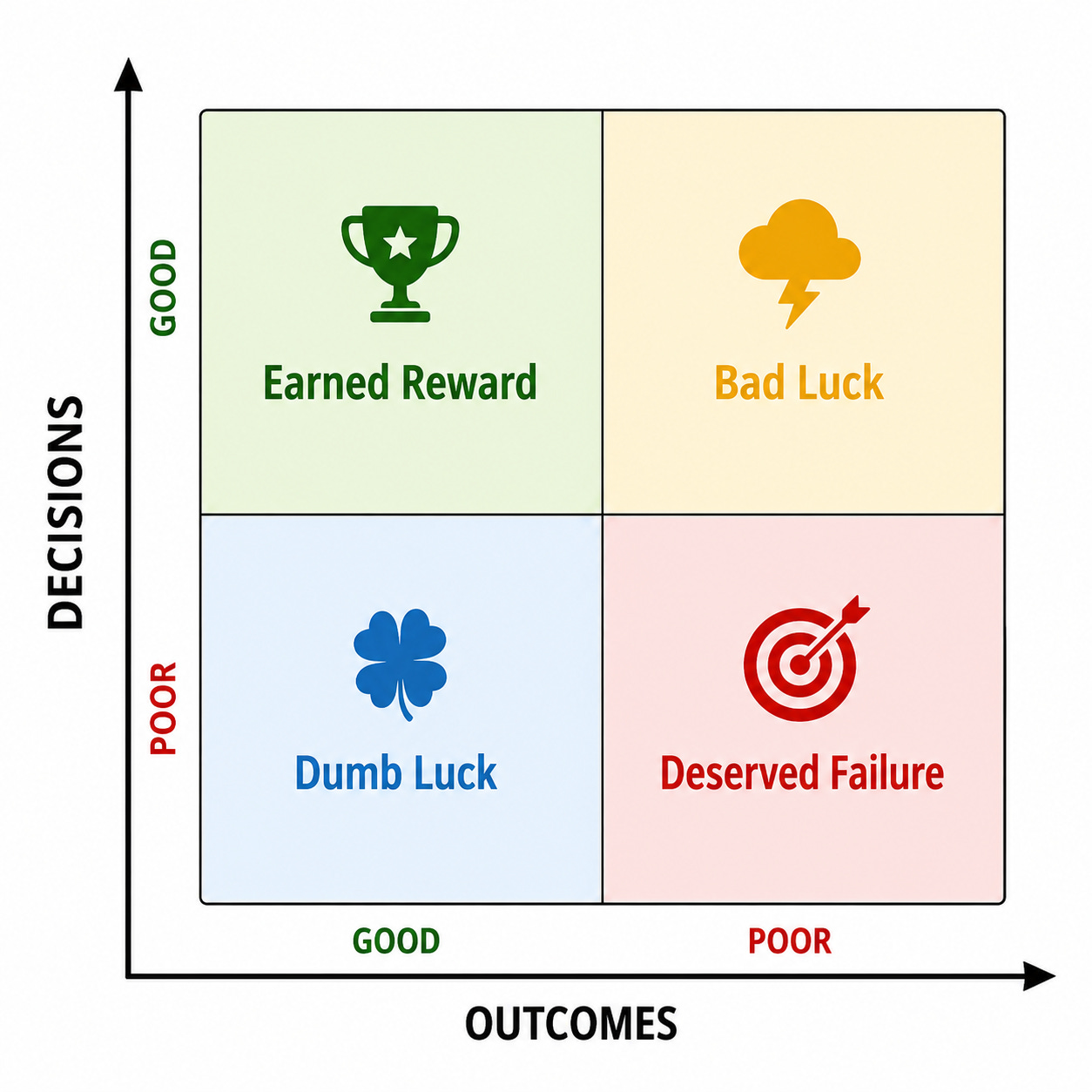
1) Good decision → Good outcome - CODIFY IT; Earned Reward
Celebrate, but don’t over learn. Still make sure your decision didn’t have a luck component.
If not, then codify the decision recipe so the org learns and makes similar type decisions in the future.
2) Good decision → Bad outcome = UNLUCKY; Bad Luck
This was a high-probability and high-quality bet that didn’t pay off this time. You were unlucky and unfortunately hit the low probability outcome (assuming you took a “low probability risk”).
This is where great companies and great teams and great decision systems are made.
Protect the decision-maker. Study the assumptions. Improve the model and the next bet.
Key Focus for this Box - If you do nothing else, do this:
Make Box #2 (Bad Luck) psychologically safe and operationally useful.
Box #2 is where the best leaders play the long game.
3) Bad decision → Good outcome: LUCKY or DUMB LUCK
The most dangerous box. It creates false confidence and repeatable mistakes.
Be the courageous one and call out this truth. Use this post if you have to.
Otherwise, your team, your company, or even you will repeat the bad decision and next time you will not likely be lucky.
4) Bad decision → Bad outcome: DECISION PENALTY BOX; Deserved Failure
Fix the process and hold the person accountable. Since it’s Stanley Cup hockey season, do they get a 2 minute minor? or a 5 minute major? in your company’s version of the “penalty box”.
Annie Duke Quotes: I’m including these quotes from her book because a) my brain loves and remembers quotes and b) they are plain great quotes.
“Uncertainty comes from hidden information.”
“Even with zero hidden information, there’s still luck involved in a simple heads/tails coin flip with only 2 outcomes. There’s always 2 sides to every bet.”
“Evolution has given humans Type 1 Errors (False Positives) and Type 2 Errors (False Negatives) and has made it worse by conditioning us for ‘Tribes’ and our ‘Beliefs’.”
“If we were more clear that every decision in life is a bet, we’d all be a lot more open minded.”
Annie Duke on probabilistic thinking:
“I don’t ever have perfect information for anything, no matter how well I think about anything. The future is always uncertain. A 99% bet still carries a 1% probability of being wrong.”
“If my beliefs are probabilistic and my bets about the future are probabilistic, then I need to be information hungry so I can refine my beliefs and refine my future predictions.”
“Now, I can be more open minded as to how I can be wrong since I already know why I thought I was right which is how I got to the decision/bet in the first place.”
A CFO/COO Operator’s Rule
Decisions are leading indicators. Outcomes are lagging indicators.
If you want better outcomes, improve your decision system:
How are your decisions framed?
Who owns them?
Are Assumptions written down?
Are Confidence and Risks scored?
How will we course correct the next decision?
The “Time-Stamped Decision” Habit
Here’s how you stop the hindsight machine.
Before the decision, capture a simple time-stamped record:
What we know (facts)
What we believe (assumptions)
Options considered (options)
What would change our mind (metrics that would prove we are wrong)
Success (metrics to increase your bet or double down)
Kill Criteria (metrics to cut, pivot, or stop)
Confidence score (0–10)
Risk score (Probability × Severity - my Risk Equation)
Review Dates (the actual dates when we’ll revisit this “Time Stamped Decision Record”)
The Aha here? You are reviewing a decision scorecard, not the emotional memory of the room.
Playbook #2: Separate Control from Concern
Now let’s layer in the second Divide & Conquer Playbook.
Being able to separate the things you can control vs the things you can’t helps keep you and your team’s sanity.
It’s a good time for the famous Serenity Prayer quote
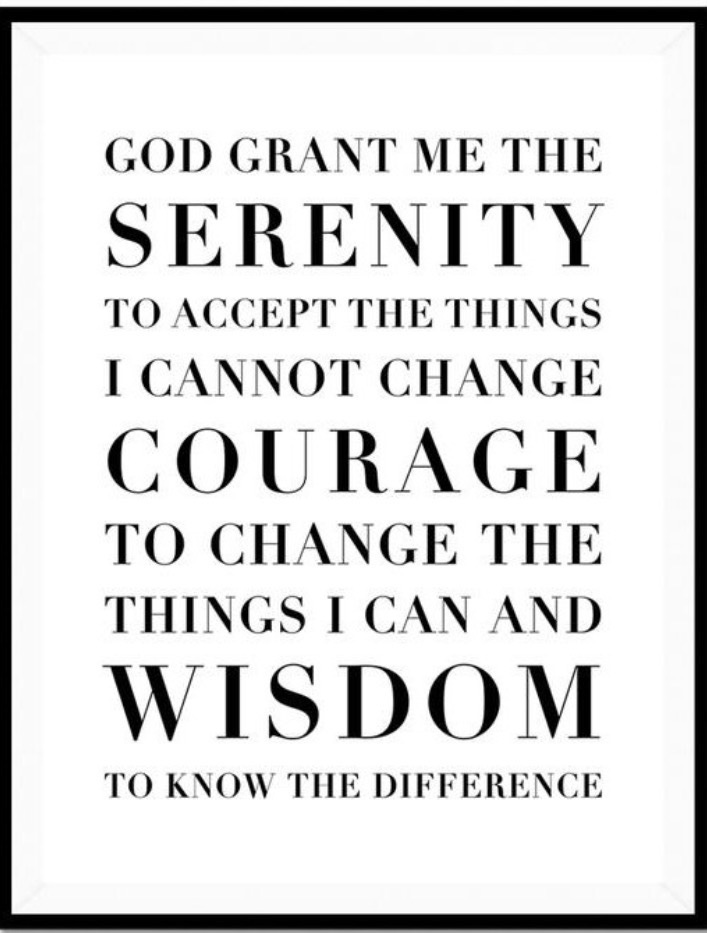
Most exec teams carry a mostly invisible mental backpack full of everything they’re worried about.
The problem isn’t the concerns inside their heads
The problem is not understanding that many of the things you are concerned about are actually outside of your control.
The problem is not having the Courage to change the things you can Control.
The CFO / COO Operator Rule:
Controls are Planning.
Concerns are simply the Inputs.
Your time and attention are scarce resources. I’ve argued in past posts that TIME is your most valuable resource.
So treat your time and attention with the value it deserves:
Control = where can you take direct action?
Influence = where can you influence others to shape the outcome you want
Concern (Risk) = where you can’t change it, but you should monitor it
If you don’t separate these, you get:
Endless meetings
Performance issues
Reactive leadership
Sloppy decisions made to relieve anxiety but don’t solve the core/root problems
A culture of emotional volatility masquerading as urgency
The “3D” Control vs. Concern Playbook:
DO
DRIVE
DETECT
Use this simple “3D” language:
1) DO (Control)
Things you can directly change.
Pricing
Hiring
Product Features
Vendor selection
Cash Runway Decisions
Operational Systems and Process
Output: a decision + owner + due date
2) DRIVE (Influence)
Things you can’t do alone, but you can influence.
Sales Execution
Customer Retention Behaviors
Manager Performance
Cross-Functional Accountability
Board or Investor Narratives
Output: a plan + coaching loop + metrics
3) DETECT (Concern; Risks)
Things you can’t control, but must monitor.
Interest Rates
Competitor Behavior
Regulatory Shifts
Platform Risk
GeoPolitical Events
Stock Market Downturns
Output: a dashboard + thresholds + pre-wired response decisions
If I sound like a broken record, this is why I’ve written about this so many times in the past. Maybe, just maybe, you’ll remember it this time! Just kidding. But seriously…
Don’t just model scenarios. Pre-wire the responses.
“Decide the future vs. Forecasting it.”
Why These Two Separations Belong Together
When you confuse decisions with outcomes, you create FEAR.
When you confuse control with concern, you create CHAOS.
Fear + chaos produces the same result every time:
Slower Decisions
Worse Accountability
Less Innovation and Experimentation
Less Learning
More Politics
“6 Powerful Questions” to Run With Your Team
Use these the next time a decision goes sideways:
Was this a good decision with a bad outcome OR a bad decision with a lucky outcome?
What were our assumptions when we made the decision?
Which assumptions were wrong? Which assumptions were reasonable?
What did we fail to measure soon enough?
What is in our control, what can we influence, and what is simply uncontrollable risk?
Would we make a similar improved decision today with upgraded assumptions and learning and higher probabilities of success?
These questions are how you build a world class decision system.
A New CFO/COO Decision Cultural Standard?
If you want one sentence to operationalize all of this, it’s this:
We don’t incentive or punish people for outcomes alone.
And
We expect our leaders to have ownership and be accountable to these 4 factors:
Decision Quality
Execution Quality
Learning Speed
Transparency of Assumptions
Bonus points: Rip up your current performance review system and build your next performance management cycle around these ownership and accountability concepts.
A Simple Challenge This Week
Run a 30-minute Decision Review on one recent “bad decision” (ahem… clears throat… produced a disappointing outcome).
2 Rules For Your 30-minute Decision Review
We can only evaluate the decision at the time it was made… not today in hindsight.
We must scorecard the decision assumptions, probabilities, and risks.
We must then be clear if we should edit/improve the decision and make it or not make it again.
If you post-mortem decisions like this going forward, you will:
Eliminate Blame and Finger Pointing
Create More Truth
Course Correct Faster
Eliminate Uncertainty With the Next Decision
Create Stronger Team Trust
If you read this far - here’s your reward. You likely haven’t seen this. So I found it for you and stored it here. For those interested in brain science + biology - this is a very good talk. I highly encourage you to invest the 1 hr.
Easter Egg… minute 24… she even talks about the 2015 Seahawks vs Patriots SuperBowl… and Pete Carroll’s 1 yd line call where after the outcome (interception). All pundits declared this the worst play call in Super Bowl history.
Annie explicitly walks through this classic example of “Resulting” where the the stats showed a 1% probability of being intercepted. This play was on 2nd down with only 1 timeout left, the Seahawks were down by 4 pts (so they couldn’t kick a FG) and were on the 1 yd line. This 1% bad outcome, 2nd down pass play, was a 99% 3 step decision of saving time if the ball was incomplete and still allowing 2 running plays on 3rd and 4th down as needed.
Minute 1:02 (1 hr 2 minutes) - Annie’s insights on Impostor Syndrome and Trusted Groups is also incredibly valuable.
Contact me if you want to go deep on this topic and workshop with me over a few months in designing and executing your company’s Decision System!
