

Presence Under Pressure
Both Presence and Pressure Reveal True Leaders

A few weeks ago I posted about Alysa Liu and the USA Hockey Team performing under pressure. This week’s post is a follow up that goes into specific detail.
I’m also eating my own “Cooking” as I just created my own T-Chart for Leadership Presence vs Leadership Pressure.
After three decades running finance and operations at companies like Intuit, Netflix, and Mozilla and now coaching today’s startup leaders, I’ve learned that the most valuable skill the best executives bring to the table isn’t IQ or technical/subject matter expertise, it’s leadership AND the ability to stay calm and “present” under pressure.
As I think back to many of my performance reviews, I now realize the words cool, calm, and collected were written into most of my reviews. Interestingly, these seem to be the most sought after behaviors especially for CFOs and COOs. Specifically, our ability to stay grounded, calm, curious, and logical in the exact moments when other execs or board members often get lost in the emotions of the situation.
Your presence in the heat of the moment amplifies every other leadership skill from your clear strategic thinking to decision-making to communication and all the way to crisp execution.
So here are the headlines I just wrote down for my personal T-Chart on Pressure vs Presence. I’ve tried to blend in my prior PlayBooks like my “Decision Making Series”, “Powerful Questions”, “Crisis Frameworks”, “The Language of Business” and “7 Olympic Lessons Learned”.
I came up with six T-Chart Headlines:
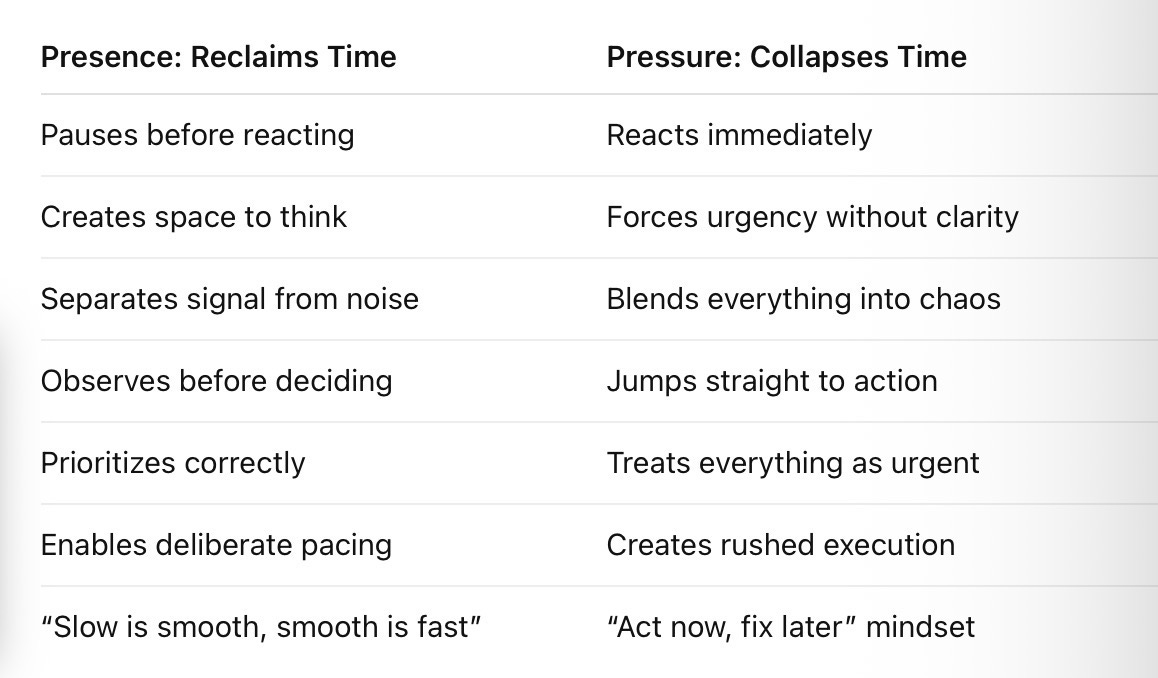
Pressure Collapses Time. Presence Expands It.
Pressure seems to accelerate everything especially when the pressure also includes a time component. Pressure speeds up your mind, quickens your assumptions, and reflexively surfaces your biases.
Presence? This is the ability to remember to breathe (box breathing is great), get oxygen to your brain and body, slow your mind, and expand vs contract your universe of options.
I love the phrase “Slow Is Smooth, Smooth Is Fast”. This exemplifies “being present” and “thinking slow vs thinking fast” (ode to Daniel Kahneman).
I just wrote about the OODA loop… so obviously these concepts are on my brain. The OODA and ODDA Loops both start with “OBSERVING” as the first step of “presence” vs instantly reacting to the pressure.
As an operating CFO, COO, or other leader, your ability to see around the corners clearly and calmly is what will separate you from the pack and be viewed as a valuable strategic thinker and credible influencer.
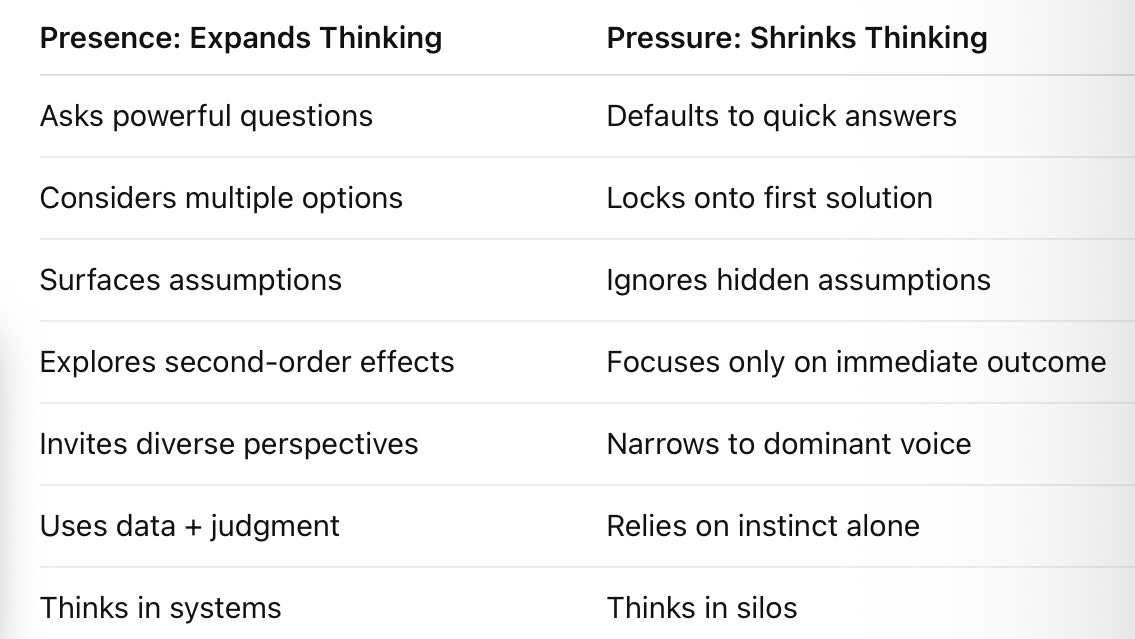
Pressure Constricts Thinking; Presence Clarifies It.
That fast breathing, adrenaline, cortisol based energy that you feel under pressure is great for “flight” but not as effective in winning the “fight”.
When your pupils constrict, your eyesight lets less light in. More often than not, less light means more “dark thinking” which tends to revert to biases and fixed mindsets born out of fear.
My Powerful Questions framework can help expand everyone’s thinking and let in more light to the situation. Great questions reduce pressure by forcing thoughtful and engaging answers.
What’s really happening here?
Are the assumptions we are making valid?
What’s the true severity of this pressure? What’s the true probability?
What data are we missing?
What are the second-order effects if we’re wrong?
How about the second-order effects from the quick decision we are about to make due to the pressure?
Great exec leaders aren’t known for having the perfect answers, they are known for asking great questions that expand possibilities and keep options open.
So slow down. Breathe. Simply Ask More Questions.
It’s amazing what transpires when you lead everyone to more information, more ideas, more possibilities, more potential solutions.
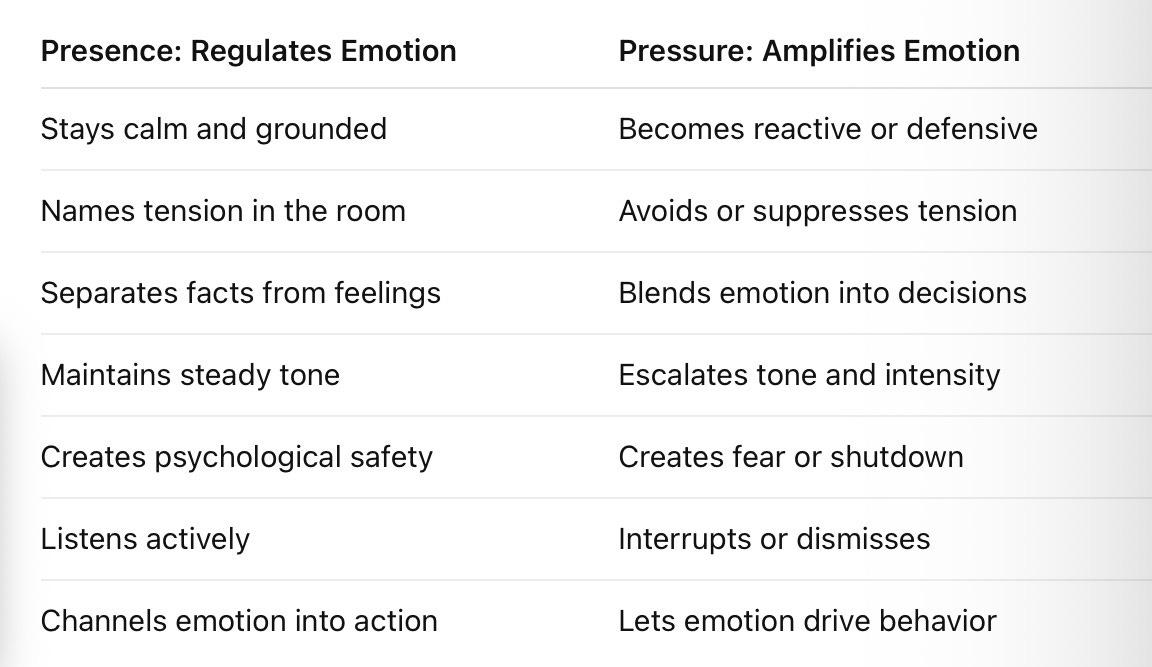
Pressure Amplifies Emotion. Presence Calms People Down.
In 2013, I was told by a few leaders I respect that “Emotions Are Data”. In other words, if you are emotionally triggered it must be very important. After all, “No Conflict, No Interest”. Therefore the higher the emotions, the higher the importance of “the thing” triggering the emotions.
In a leadership room, emotions always exist though they are often unspoken, unmanaged, and underestimated.
This is where my T-Chart Framework becomes a secret weapon.
When pressure is high, the conversation splits into two tracks:
Left Column: the visible facts, numbers, models, and risks
Right Column: the invisible feelings, fears, expectations, personal stakes
Under pressure, most leaders double down on the left side.
Presence means focusing on the Right Column to better inform the Left Column.
At Intuit, Scott Cook and Bill Campbell were masterful at this. They didn’t just manage the work; they managed the room’s energy. They normalized fear, uncertainty, and confusion and most times were able to redirect the fear into action. They kept the room honest, grounded, and productively moving forward in the highest stress situations.
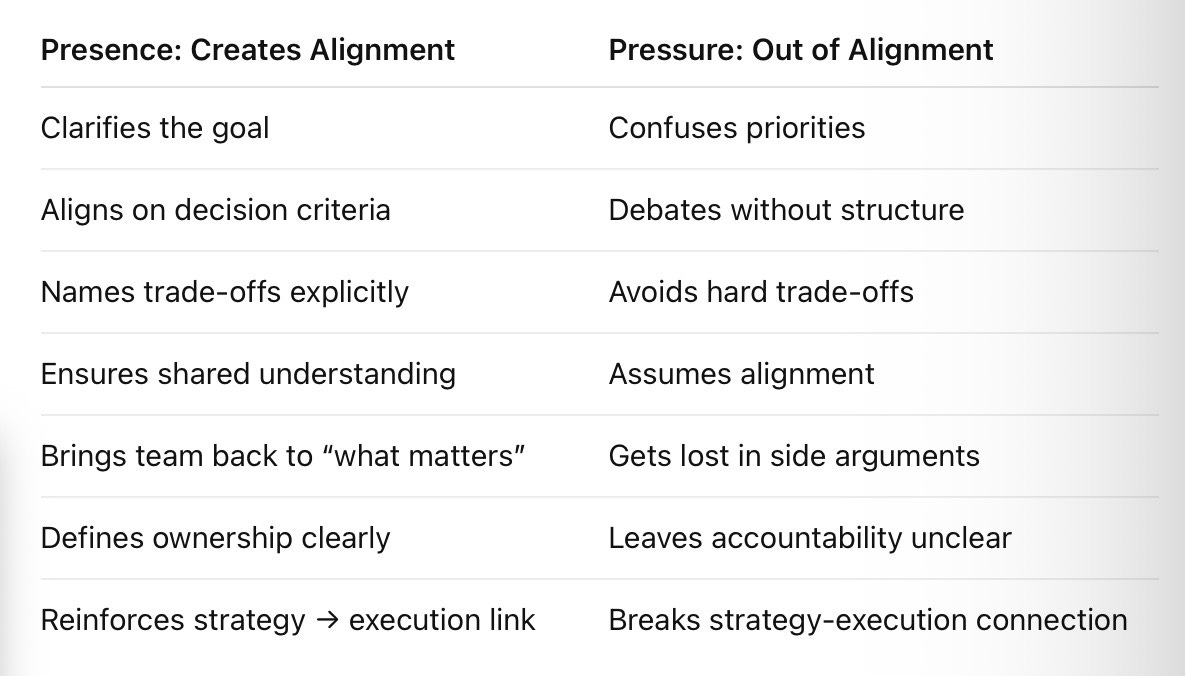
Pressure Tests Alignment. Presence Creates It.
In my Strategy–Structure–Execution Alignment post, I wrote that misalignment is the silent killer of teams and companies.
Pressure exposes misalignment the same way storms expose weak architecture.
Your presence, especially if you are a CFO or COO, shows up in three key moves:
Name the misalignment.
Translate the confusion into a clear decision framing. (E.g. what we know, don’t know, and when we’ll know more, data required, key decision deadlines.)
Guide the room back to executional next steps aligned to this framing.
Presence is the keystone that holds the executive arch together when the load increases.
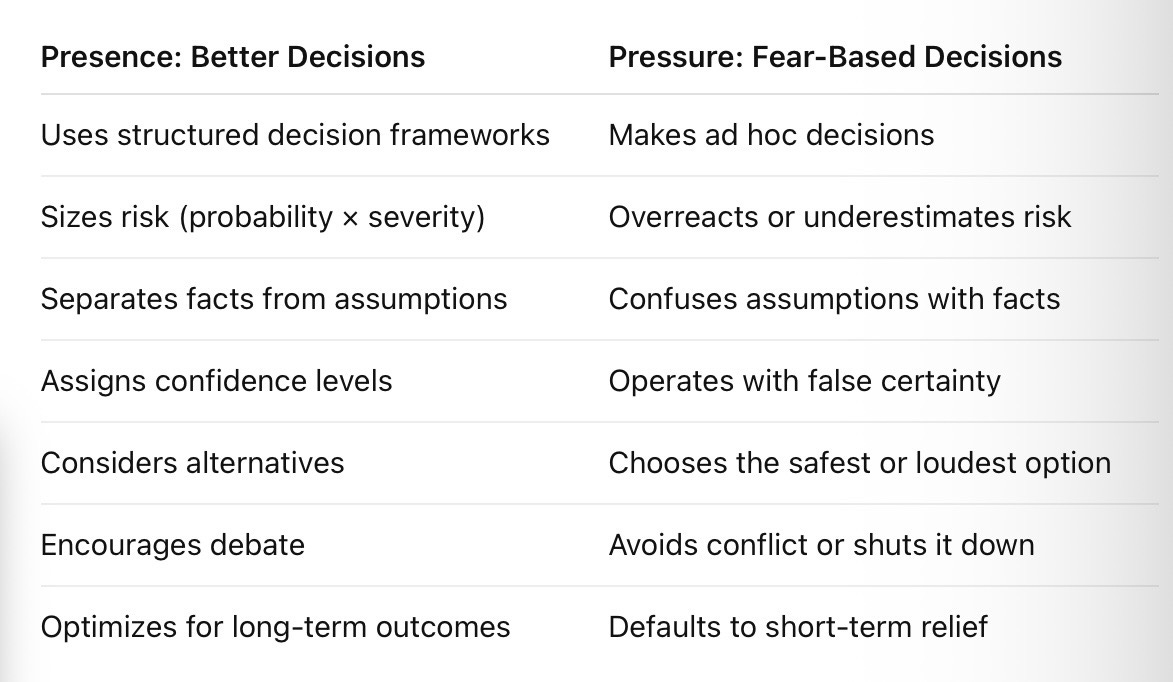
Pressure Demands Quick Decisions. Presence Produces Higher Quality Ones.
In my Decision Architecture posts, I argue something counterintuitive:
The job of an executive is not to be right.
The job is to create the conditions for the best decision available to be made.
Your “Keep Calm and Carry On” type presence is what enables that.
Without presence:
Fear drives decisions.
Egos and loudest voices crowd the room.
Time pressure distorts decision quality.
Group dynamics corrupt decisions without proper alignment.
With presence:
Risk gets sized appropriately (Probability × Severity).
Options get compared objectively.
Assumptions get surfaced and scored.
Ownership becomes explicit.
Deadlines become the team focus.
Presence doesn’t guarantee you’re right.
It guarantees you’re moving forward with clear alignment and the best ideas and actions you can take in the moment.
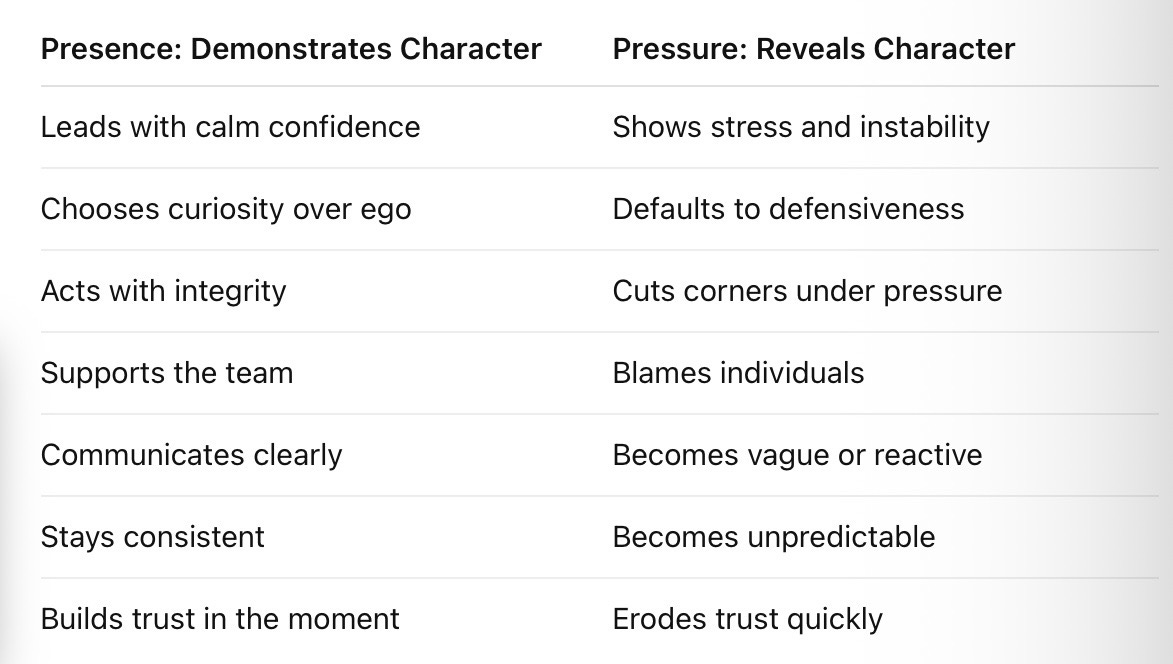
Pressure Reveals Character. Presence Demonstrates It.
At Mozilla, we scaled from 18 to over 1,000 people. Hyper-growth is, by definition, a pressure cooker. What separated the leaders who thrived from those who burned out was not raw capability, it was their leadership character, focused on their teams and the company culture and their ability to stay “present”.
They say pressure reveals your true character. I say, your ability to stay present is what people will remember and will help define and demonstrate your leadership.
Presence shows up as:
Calm tone when others elevate.
Curiosity when others get defensive, loud, or angry.
Clarity when others go off script and create chaos.
Courage when others play it safe, hedge, or simply freeze up.
Presence doesn’t mean being soft. You can have presence and be quite firm. Presence is focused force. Think Yoda.
Your presence ultimately builds trust… when all others are losing their heads around you. Think “IF” by Rudyard Kipling.
The 7 Step PlayBook: How To Create Presence Under Pressure
Here are 7-steps that I coach for creating presence under pressure:
Breathe, Then Speak.
Deep breaths. The 10 second rule. Super hard to do but it’s a rule for a reason.Label/Name the Moment.
“This is a high-stakes decision. Let’s slow down and get it right.”Separate Facts From Assumptions.
Use your Decision Architecture muscles. Define assumptions vs facts. Turn opinions into data.Ask One Powerful Question. Then Ask Another One.
The right questions can literally change the emotions in the room. Somebody needs to ask them. Try to make it you.Surface the Right-Column Dynamics (see above in this post)
What’s unsaid that needs to be acknowledged?Re-Align. Re-Focus the Room.
What are we solving for? Who owns the next step?Make the Next Action Decision. Also prepare the course-correcting next-next action at the same time. Try to operate 3 steps ahead.
Presence is a lots of reps practicing these 7 steps.
Under pressure, your presence becomes the room’s new operating system…
…and you create the Leadership Environment for winning.
I’ll leave you with a story that a very good friend and business colleague just texted me a few days ago that exemplifies this whole post. I’ve edited this post to quickly add this story. It still gives me goose bumps since my good friend was actually on this particular flight 8 years ago. This is the “Presence Under Pressure” true story of Tammi Jo Shults (pilot) and my good friend Jim Demetros who was on that fateful flight.
If you are a leader of any type, there are crisis moments like the one below which literally can be the difference between life and death or maybe only the difference between the life and death of your company.
Be Tammi Jo Shults in that moment!
8 Years Ago, April 17 2018:
“There wasn’t time to be scared. Only time to fly”
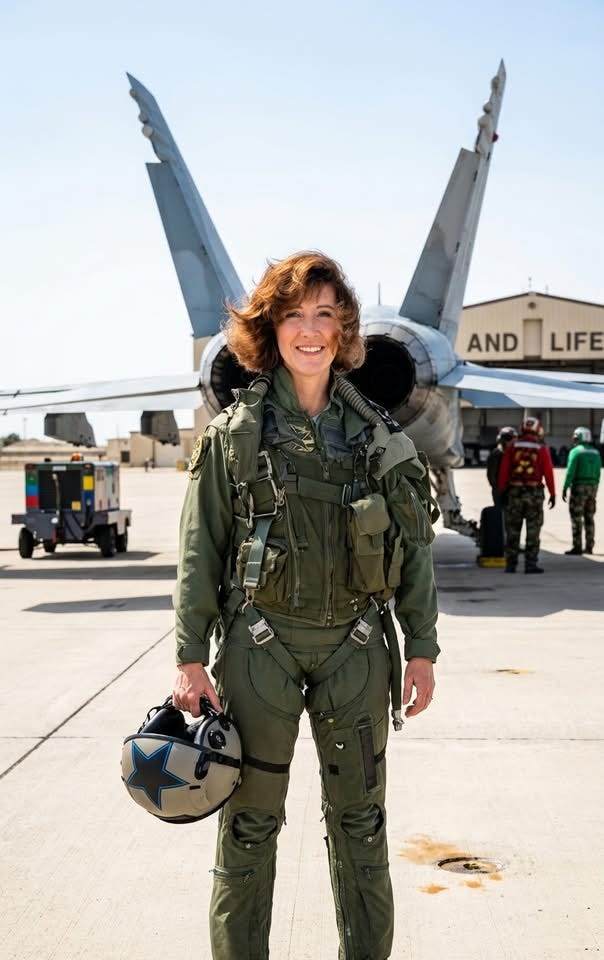
At 10:27 AM on April 17, 2018, Southwest Flight 1380 departed LaGuardia Airport in New York with 144 passengers and five crew members, headed for Dallas. The captain was Tammie Jo Shults. The morning was routine.
Twenty minutes into the flight, at 32,000 feet over Pennsylvania, the left engine came apart.
A fan blade had developed metal fatigue — a microscopic structural failure in metal that had been flexing and cycling through takeoffs and landings for years, invisible to inspection, building toward a threshold. When it reached that threshold, the blade broke free at operating speed and tore through the engine casing from the inside. Metal debris ripped through the wing and into the fuselage. One piece struck window 14A.
At 32,000 feet, the pressure differential between inside and outside an aircraft is violent. The window failed. The suction was immediate. Jennifer Riordan — a forty-three-year-old wife and mother of two from New Mexico who had boarded a routine business flight — was partially pulled through the opening before other passengers could reach her. They pulled her back inside. Her injuries were catastrophic.
In the cabin, oxygen masks dropped from the ceiling. The vibration from the damaged engine and asymmetric thrust was severe enough that passengers were not certain the aircraft was still structurally intact. They texted their families.
The plane is going down. I love you.
Tell the kids I love them.
We’re going to crash.
In the cockpit, Tammie Jo Shults was flying.
She had declared an emergency and requested Philadelphia International — the closest airport with adequate runway and emergency services. She was managing an aircraft that wanted to roll left from the asymmetric thrust of one remaining engine, fighting controls through vibration severe enough to make the instrument panel difficult to read, navigating the damage assessment in real time.
She keyed air traffic control.
“Southwest 1380, we’re single engine. We have part of the aircraft missing, so we’re going to need to slow down a bit.”
She paused.
“Could you have medical meet us on the runway as well? We’ve got injured passengers.”
The audio of that transmission went viral within hours of the landing.
Aviation professionals and ordinary people alike listened to it with the specific quality of attention that genuine mastery commands — the recognition of someone operating at the outer edge of their capability with a composure that sounds, to the untrained ear, like nothing at all.
Part of the aircraft missing. Slow down a bit.
Not the language of crisis. The language of someone who has already, in the first seconds, assessed the situation and decided: we are landing this aircraft, here is what we need, here is how we proceed. (« My note: if you recognize this is my OODA Loop post in real life-real-time)
What the passengers on Southwest 1380 did not know — what they had no way of knowing, because Tammie Jo Shults was not a person who announced her history when she boarded a flight — was where that voice had come from. What three decades of experience and refusal and training had gone into producing those fourteen words delivered in that tone.
She had been twelve years old, standing at an airshow in New Mexico in the early 1970s, when she watched planes move through the sky and turned to her father and said she wanted to do that. Her father told her she would.
The world said otherwise.
When she pursued military aviation, the structure she encountered was not ambiguous about its position. Women could hold support roles. Women could teach, administer, manage.
The cockpit of a combat aircraft was not a space the institution had designated for women, and the logic that maintained that designation was circular and designed to be self-reinforcing: combat roles were closed to women, fighter pilots were combat roles, therefore fighter pilots were closed to women, and since women had never been fighter pilots, there was no evidence they could be.
She applied to the Navy’s Aviation Officer Candidate School. She was rejected. She applied again. She kept applying until, in 1985, the Navy accepted her — not as a combat pilot, which was still closed to her, but as an instructor. She could teach men to fly jets she was not permitted to fly in the roles she had trained for.
She took the job. She taught. She watched men with less capability advance into positions she was systemically excluded from, and she kept teaching and kept flying and kept building the hours and the skills that the institutional exclusion told her she would not need.
In April 1993, the Department of Defense lifted the combat exclusion rule for women. Tammie Jo Shults, then thirty-one, applied immediately for the F/A-18 Hornet program.
The F/A-18 is a supersonic multi-role fighter aircraft — air-to-air combat, precision ground attack, carrier operations. The training is demanding and the operational requirements are unforgiving. She became one of the first women to qualify.
The Navy, having recognized what she could do, made her an instructor in Out of Control Flight — the specific discipline of teaching pilots how to manage aircraft that have departed normal flight parameters, when the standard protocols have failed and recovery requires judgment and physical skill developed over thousands of flight hours.
They also made her an aggressor pilot — flying as simulated enemy in training exercises against Navy squadrons, including against TOP GUN students.
To be an aggressor pilot is to be used as a challenge, which means you are used because you are better than average. The institution that had told her women couldn’t be fighter pilots was using her to test its best pilots.
She left the Navy after more than a decade of service and joined Southwest Airlines in 1994. She flew commercial routes — the ordinary, productive, routine business of getting people where they were going — for the next twenty-four years. Passengers who boarded her flights had no particular reason to know any of this.
She was Captain Shults. Professional. Calm. Excellent.
At 10:47 AM on April 17, 2018 — twenty minutes after the engine failed — she touched down at Philadelphia International Airport.
The landing was smooth. Controlled. The aircraft rolled to a stop and emergency vehicles surrounded it. Passengers who had been composing final messages to their children looked at each other in the specific disoriented way of people who expected something that did not happen.
Jennifer Riordan died from her injuries. Eight passengers sustained minor injuries. One hundred forty-three people walked off that aircraft because the person in the cockpit had used thirty years of preparation to make twenty minutes of controlled, professional excellence look like a routine diversion.
Tammie Jo Shults got off the plane and walked back through the cabin to speak individually with passengers. One described her voice as sounding like a mother — the specific quality of calm that communicates:
“I know where we are, I know how to get there, we will be all right.”
When the media arrived with awards and celebrations and interview requests, she deflected. She credited her co-pilot Darren Ellisor. She credited the flight attendants who had performed CPR and managed the cabin under conditions of genuine panic. She said: “Any pilot would have done the same.”
Aviation experts, reviewing the circumstances — single engine operation, structural damage, severe vibration, the specific management of an aircraft actively resisting controlled flight — said that was not accurate. Many pilots would not have succeeded under those conditions.
A reporter asked if she had been scared.
She paused.
“There wasn’t time to be scared,” she said. “There was only time to fly.”
She returned to flying.
Because that is what she does — what she has always done, since she was twelve years old at an airshow in New Mexico and decided that the sky was where she was going, regardless of what every subsequent institution told her about who the sky was for.
The Navy told her women couldn’t fly jets.
She spent eight years applying until they had no choice.
She spent three decades building the competence that would be visible, finally and completely, in fourteen words transmitted to air traffic control while 144 people texted their families goodbye.
We have part of the aircraft missing. We need to slow down a bit.
The plane wanted to crash. She had not spent thirty years preparing to let it.
Captain Tammie Jo Shults. Born December 30, 1961.
U.S. Navy. F/A-18 Hornet Pilot
Out of Control Flight instructor.
Aggressor pilot (Top Gun - Jester style!).
Southwest Airlines, Captain, 1994–present.
Southwest Flight 1380. April 17, 2018.
And when an engine exploded at 32,000 feet, she landed the plane.
“There wasn’t time to be scared. There was only time to fly.”
Personal note on Jim Demetros (who I mentioned was on this plane).
I didn’t know Jim before this incident, I’ve known from his stories and from others that knew him that he always exemplified the leadership qualities described above (he worked directly with Steve Jobs after all).
I did have the pleasure of working very closely with “Jim D” shortly after this incident and like most incidents of this nature. I believe it sharpened his skills, his focus, and his outlook on life. He certainly “brought it” during my tenure with him and that’s all you really want from any leader.
The leader I knew was the pilot of his organization and he definitely knew how to command the “plane” when it mattered while letting his team take the credit (just like Tammi Jo).
He knew instinctively and would have you know the following:
Teams always comes first.
Leadership is about delegating ownership to the lowest levels of his organization.
Setting the vision and the course of the team’s next actions was critical
Taking control and commanding the org to pivot in the moment to save the plane (company) with class, confidence, and calmness was critical
I watched him do all this and more as an exceptional leader and in the quiet moment after the all hands or the exec offsite he would softly tell you why. That nothing else was as important or as big a crisis as that day… and the fact that he was still here gave him the freedom to follow his instincts and be a leader without reservation or fear of being 2nd guessed.
Final note: next time you are deep in a crisis and you are a leader or the pilot of your team, conjur up your best Tammi Jo Shults or Jim D and simply fly the plane and
“Just Lead”.

