The Data - Decision - Wisdom Pathway & the Power of Collective Intelligence
The Power of Collective Intelligence

My former Mozilla team will definitely remember this one. I’ve been talking about the Data to Decision Pathway since at least 2011. The framework still holds true today.
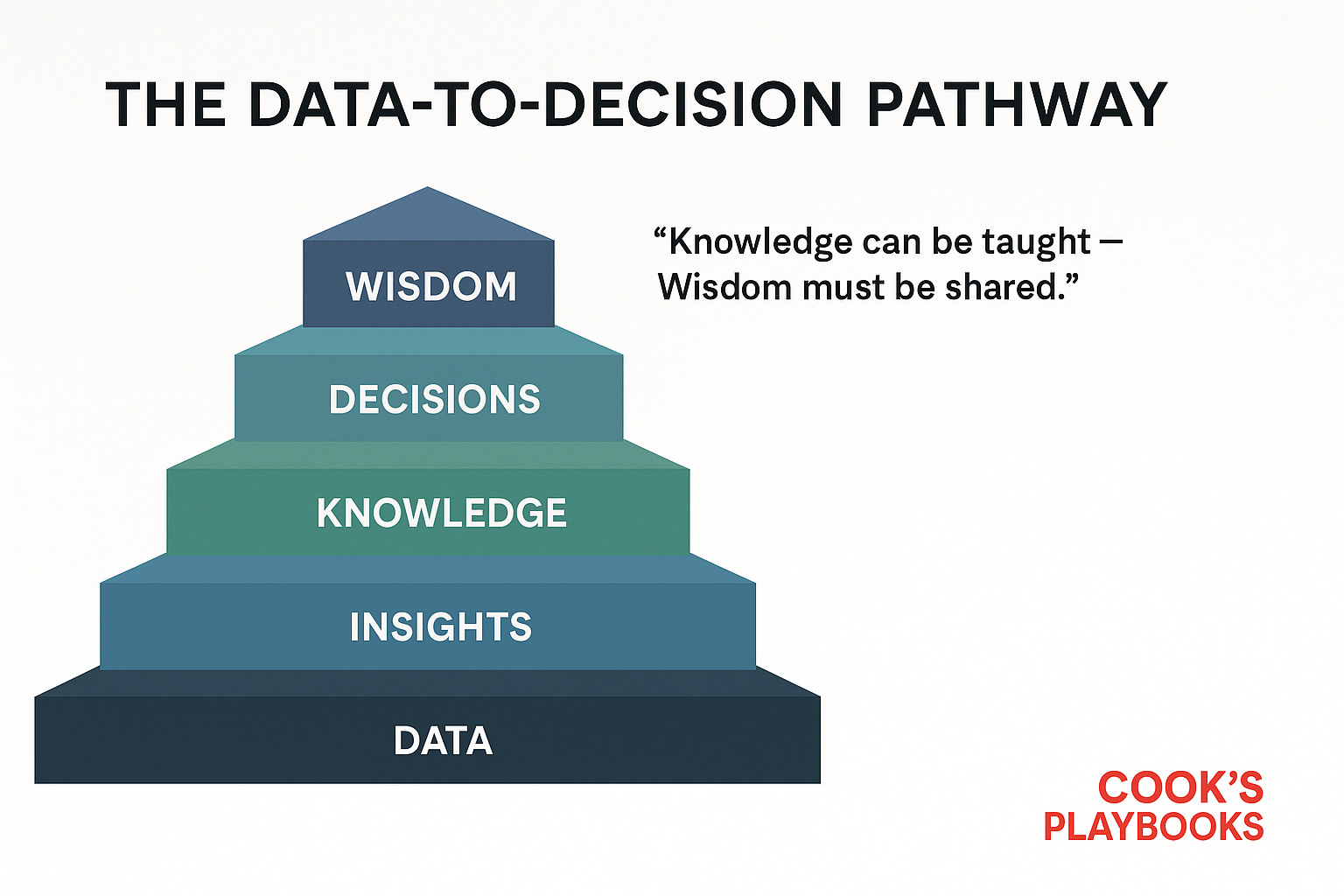
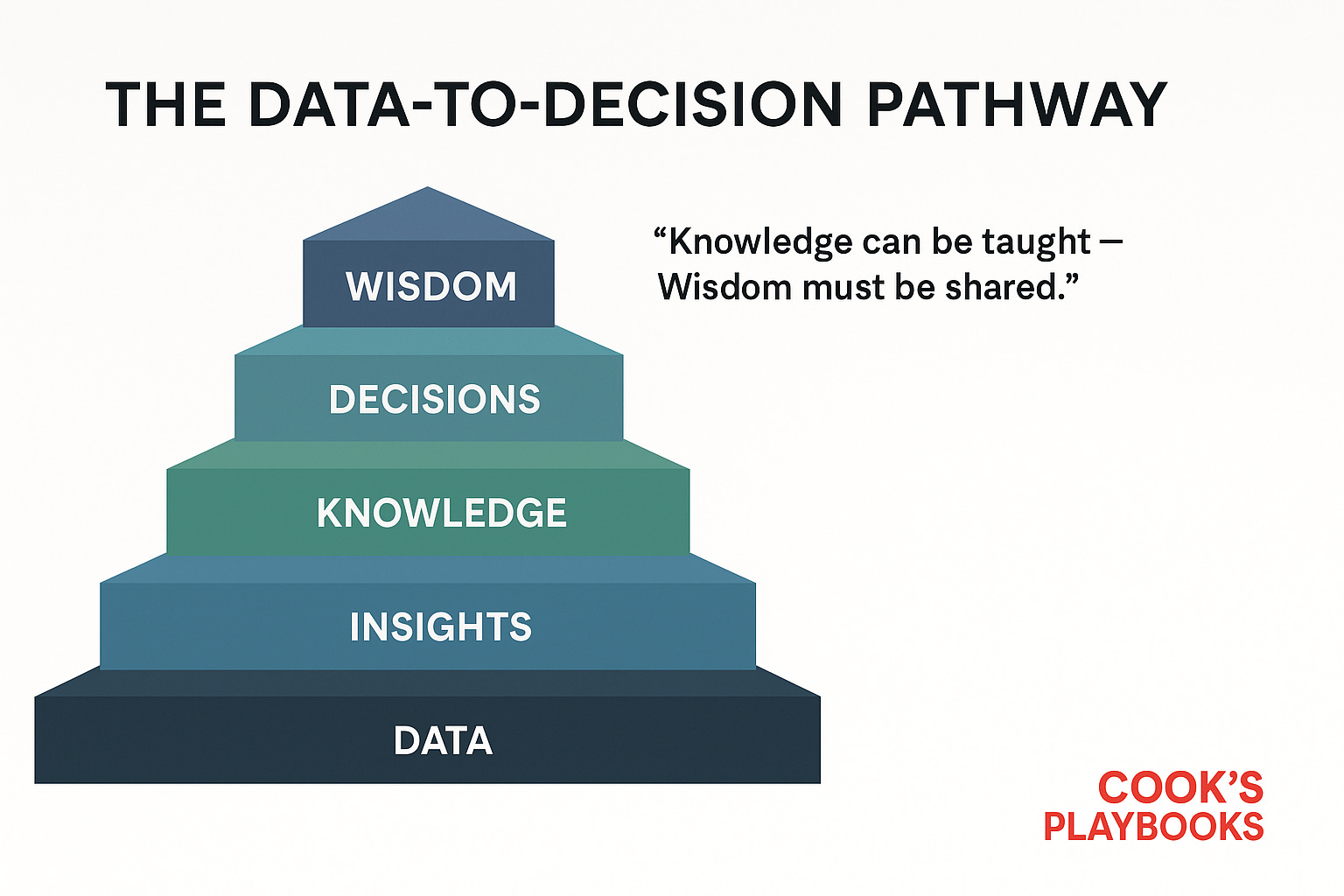
Every great company builds its decision making systems on one universal pathway:
Data → Insights → Knowledge → Decisions → Wisdom
It sounds linear but it’s actually more layered/leveled (think autonomous driving and its Level 1 to Level 4 metaphor). Each layer is actually the building block to the next higher layer.
Data is Layer/Level 1
All companies are seeking more and more data and since “Big Data” hit the scene (around 2011), for awhile we thought “more data” was better. And then we realized we needed to desperately create data signal from the vast universe of data noise. More data was not always better and many times it was worse.
Zooming out, however, we realize data itself has zero value until it’s organized, structured, and put into context vs other data.
Good CFOs lead data accuracy. Great CFOs demand their team and other teams to turn data into critical insights as the foundational elements of making better decisions.
Insights = Layer 2
Ok. We have good structured data now. But throwing numbers and data at people in dashboards and assuming people can see the forest through the trees of your awesome visualization and calling it a day isn’t the way to go.
The next layer required = insights. Insights are derived only from trends. The famous saying goes “2 data points make a line; 3 data points form a trend”. Yes, trends and graphs are the only way to compare current data vs past data and attempt to forecast future data. Insights are the domain of FP&A. Note: I’ve never liked the term as it discounts the true value of Financial Planning teams… it really should be named FP&I (Financial Planning & Insights).
You must call the insights out specifically - and clearly explain the “why” behind the “what” of the data. Headlines, verbal statements, storytelling the insights. 7 times, 7 different ways until the Insights are what people remember…not the data/numbers.
Insights are what emerges when data meets pattern recognition and curiosity. They’re the “aha moments” that reveal why something happened and what might happen next.
Insights are created when a team learns to ask better questions such as “What surprised us?”
In my “Powerful Questions” framework, I’ve often said: the quality of your insights is directly correlated to the quality of your questions. That’s how great operators separate data signal from noise.
Knowledge = Layer 3
Insights shape knowledge. Knowledge is the layer of learning where your insights become teachable. Your knowledge layer allows you to convert your insights into systems and where your historical experiences (learnings) become your personal playbooks.
So write it down! Document the insights. Create you Knowledge Insights database to draw upon in the future. Collecting and referencing all past and current insights is critical to making future decisions.
Decisions = Layer 4
Ok. So you’ve done the layer 3 work and have created a kick ass Knowledge Base. Your goal now is to continuously update layers 1-3 to make higher quality and higher velocity decisions.
Decisions are where all your data, insights, and knowledge all come together. This is where what you “think you know” or have instincts and opinions gets tested in the real world. Your personal and company “decision architecture” is your most valuable asset that must be designed, tested, and improved (what I call course-correcting) over time.
The best teams build pre-wired decision systems that allow them to move faster with confidence and quality and allows them to course-correct when new data emerges requiring new decisions.
I wrote a whole 3 part series on Decision Systems awhile back. Use substacks search feature to go find it and to triple click if you want to dive deeper on how to build your decision systems.
Wisdom = Layer 5
Wisdom is what happens when your knowledge and decisions are stored and shared collectively across teams. Wisdom requires multiple reps (lots of experience; a.k.a “mistakes” and “learning”) to truly understand what to do next, and maybe more importantly what not to do, and most importantly when. Wisdom is where deep experience becomes shared playbooks.
Ok… to lighten things up a bit, here’s classic joke that helped me and maybe it will help you how to remember the key difference between Knowledge and Wisdom:
“Data is knowing a tomato is actually a fruit and not a vegetable. Knowledge is knowing why. Wisdom is not putting it in a fruit salad.”
At Intuit, Netflix, and Mozilla we built a culture of wisdom-sharing long before “knowledge management” became fashionable. Innovation labs, postmortems, A-B testing/learnings, early days operational wiki’s (ahead of everyone else). Our customer feedback wasn’t trapped in silos; we shared our learned widsom transparently and openly across every function of the company so we didn’t have to re-learn things and to enable us to go faster.
That’s the power of collective knowledge or collective intelligence. When a company or culture ritually passes along knowledge and wisdom, companies and cultures become legendary and worthy of story-telling of how they “did what they did”. Think Netflix’s culture deck or how Firefox built our community of developers, or Intuit’s famous customer programs.
Collective intelligence turns every decision into a living learning systems. The ultimate result is compounding wisdom.
The C-Level Role
For modern C-Level execs, the challenge and the opportunity is to architect the decision systems to create stronger and stronger wisdom layer.
Design and build your company’s Data Foundation.
Drive Insight generation and thinking based on pattern matching the data.
Document, Codify, and Communicate the Knowledge.
Invest in Wisdom-Sharing systems and time. Invest the time to storytell successes and failures.
Increase your decision velocity under the 80% probability, thinking in bets, risk curve frameworks.
Improve your decision quality by course-correcting the 20% part of the decisions that need improvement.
That’s the Data-to-Decision-Wisdom pathway. You will find versions of this operational infrastructure behind every great team and company.
Final Thoughts:
Data will always tell you what’s happening.
Insights explain why.
Knowledge ensures it can be taught and repeated.
Wisdom when shared openly ensures the collective knowledge and intelligence translates into growth.
Try to turn all your data into wisdom or at least build the internal systems and communications structures to do so.