

Trillion Dollar Economic Cycles
A historical review of trillions of dollars injected from our last 3 economic cycles and the trillions now being invested in our new AI cycle.

The word “trillion” wasn’t a part of my regular vocabulary growing up. I honestly don’t recall many people using the word “trillion” in everyday language until the last 5 years or so.
Aileen Lee coined the term “Unicorn” in 2013 to designate startups valued at a “billion” dollars. For personal perspective and context, Intuit in 1993 was the 4th largest software IPO ever with an IPO price of $300M valuation. Netflix went public in 2002 at the same $300M IPO valuation.
Aileen’s original post (for history sake) is here: Welcome To The Unicorn Club
From the 2013 original article:
“We found 39 companies belong to what we call the “Unicorn Club” (by our definition, U.S.-based software companies started since 2003 and valued at over $1 billion by public or private market investors). That’s about .07 percent of venture-backed consumer and enterprise software startups.”
And her follow up here: Follow Up Post - 10 yrs later
Tl;dr: It’s now time to unpack “trillions.” This is another long post. I “write things down” so that when we fast forward 5-10 years, we have a place to remember “where we were” vs. what appears to be in the future state of “normal.”
Here’s the top level summary of this post:
For the last 20 years, the U.S. economy has been shaped by 3 major trillion-dollar capital injections into our economy in the forms of:
2008-2012 Defensive Capital: mortgage crisis - great recession; $3-$4 Trillion
2012-2020 Financial Engineering Capital: ZIRP near 0% interest rates; $2-$3 Trillion
2020-2021 Consumer Liquidity Capital: Covid: $4-$5 Trillion; March 2020 Cares Act (PPP Loans of +$2 Trillion; America Rescue Plan of $2 Trillion in March 2021)
2025-Today AI Infrastructure Capital: $2-$3 Trillion (so far!); Goldman predicts over $7 Trillion from 2026-2031 for the continued buildout of data centers, chip fabs, energy grids and nuclear, cloud hyper-scaler infrastructure; robotics
We are once again rewiring our economy with trillions of dollars. Like the past trillion dollar cycles, we need to recognize the significant impacts of such capital deployment cycles on:
company valuations
labor markets
business models
operating models
competitive advantage itself
Bottom line: capital cycles like this require CEOs and CFOs to re-evaluate their strategies to ensure their products, GTM motions, and R&D models continue to be aligned with their customers and competitive offerings.
LEARNING FROM HISTORY
History is an important teacher. Over the last 20 years, the U.S. economy has gone through one of the greatest capital deployment experiments in modern history.
When I started my career, “billions” was the term that caused most to pay attention.
Today it’s “trillions.”
We had zero trillion companies in June 2018. I’m excluding the oil company anomalies of PetroChina and Saudi Arabia Aramco.
Apple became our very first trillion dollar company in August 2018, quickly followed by Amazon in September 2018.
Microsoft was #3 in 2019 followed by #4 Alphabet (Google) in January 2020.
We only had these 4 when Covid hit in early 2020, and it wasn’t until June 2021 when the “T-Club” then quickly added two more - #5 Meta (Facebook) and then #6 Tesla in October 2021.
It wasn’t until May of 2023 when we added #7 Nvidia.
Today, we have 14 companies in our T-Club with 12 of the 14 being technology companies and the other 2 being Berkshire Hathaway and Eli Lilly.
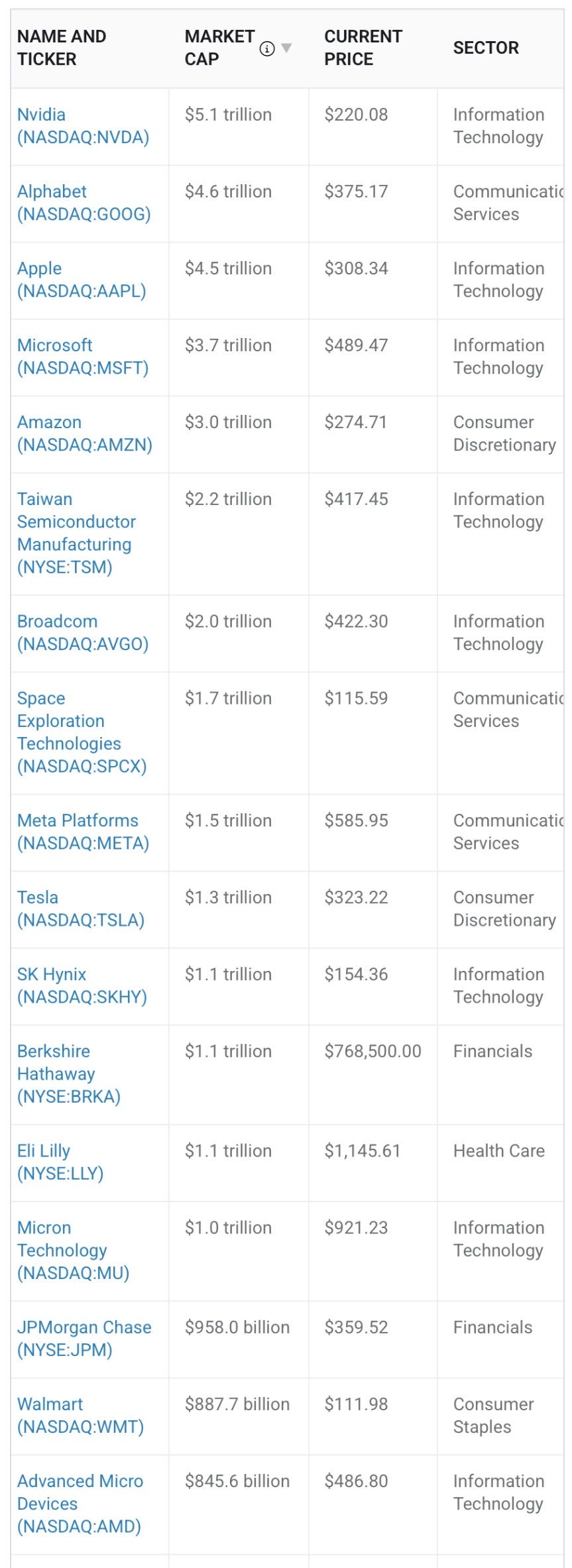
How did we get here? My take? Two main sources. The US government injected trillions into into our financial system in addition to Mid-East Oil money being injected into the US.
Let’s walk through the last three major “Trillion Dollar Capital Cycles.”
Cycle #1 (2008–2009): The Financial System Rescue: $3-$4 Trillion
“Too Big To Fail”
The first major modern trillion-dollar intervention arrived during the housing collapse and global financial crisis.
The U.S. financial system was on the brink:
Lehman Brothers collapsed
Bear Stearns disappeared
AIG (largest insurance company) nearly imploded
major banks froze lending
housing prices cratered
consumer confidence collapsed
The government response was unprecedented injecting in the range of $3-$4 trillion of new dollars into our economy.
From Google search:
Between 2008 and 2012, the U.S. government and Federal Reserve injected trillions of dollars into the economy to fight the financial crisis. This included $443.5 billion disbursed through the Treasury’s Troubled Asset Relief Program (TARP) and roughly $2.3 trillion from the Federal Reserve’s first two rounds of Quantitative Easing (QE1 and QE2), plus massive emergency lending facilities. [1, 2, 3, 4]
Major Capital Injections and Programs (2008–2012)
TARP (2008–2010): Authorized at $700 billion and later reduced to $475 billion, final total disbursements reached $443.5 billion. It injected capital into banks ($250 billion), AIG ($70 billion), the auto industry ($82 billion), and foreclosure prevention ($46 billion). [1, 2]
QE1 (Nov 2008 – Mar 2010): The Federal Reserve pumped roughly $1.75 trillion into the economy by purchasing mortgage-backed securities, agency debt, and long-term Treasuries. [1, 2]
QE2 (Nov 2010 – Jun 2011): The Federal Reserve injected an additional $600 billion by buying long-term U.S. Treasury securities. [1, 2]
QE3 (Announced Sept 2012): Began an open-ended purchase of $40 billion per month in mortgage-backed securities, scaling up further into 2013. [1, 2]
Federal Reserve Emergency Lending: Beyond QE, specialized Fed liquidity and lending facilities peaked at over $1 trillion in emergency short-term credit extended to financial institutions. [1]
This cycle was fundamentally Defensive Capital with a clear goal of US Economy survival to prevent systemic collapse, save the banking system, and restore consumer confidence.
This era taught markets something critical: the Federal Reserve would intervene aggressively when systemic risk appeared. This realization permanently changed investor psychology with respect to debt and equity.
Risk pricing changed forever.
Cycle #2 (2012–2020): ZIRP - The Zero Interest Rate Policy Era; $2-$3 Trillion
“Cheap Money Changes Everything”
After the financial crisis, interest rates effectively went to zero for nearly a decade. This wasn’t just monetary policy; it became “the new normal” and we all became a bit numb to a new operating environment.
Money became almost free. “Cash is trash” became a mantra.
What Happened?
venture capital exploded
SaaS valuations soared
growth was prioritized over profits
private equity leveraged aggressively
tech hiring accelerated
asset prices inflated across nearly every category
This 8 year period normalized:
cash burn
perpetual fundraising
revenue multiples detached from fundamentals
aggressive expansion strategies
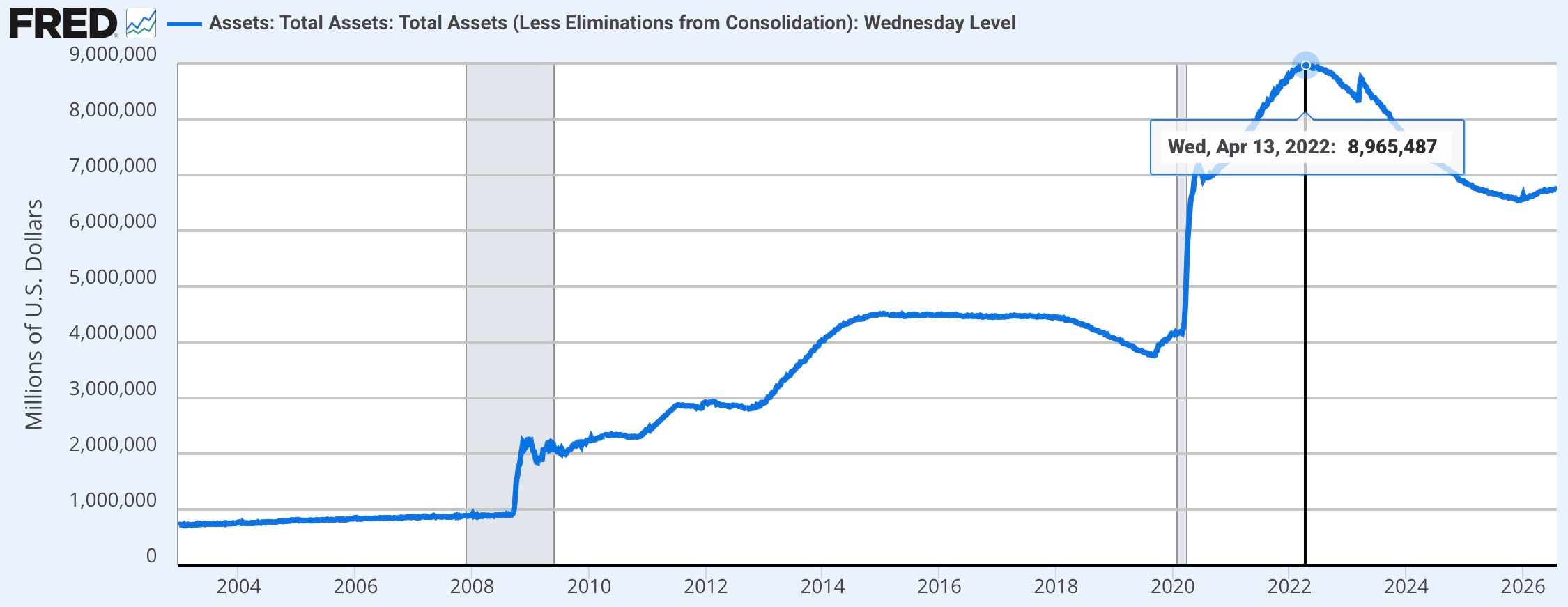
The Fed balance sheet expanded from under $1T pre-crisis to roughly $4.5T+ pre- COVID and then ballooned to nearly $9 Trillion (doubling in 2 years). Today, the Fed’s balance sheet is just under $7 Trillion.
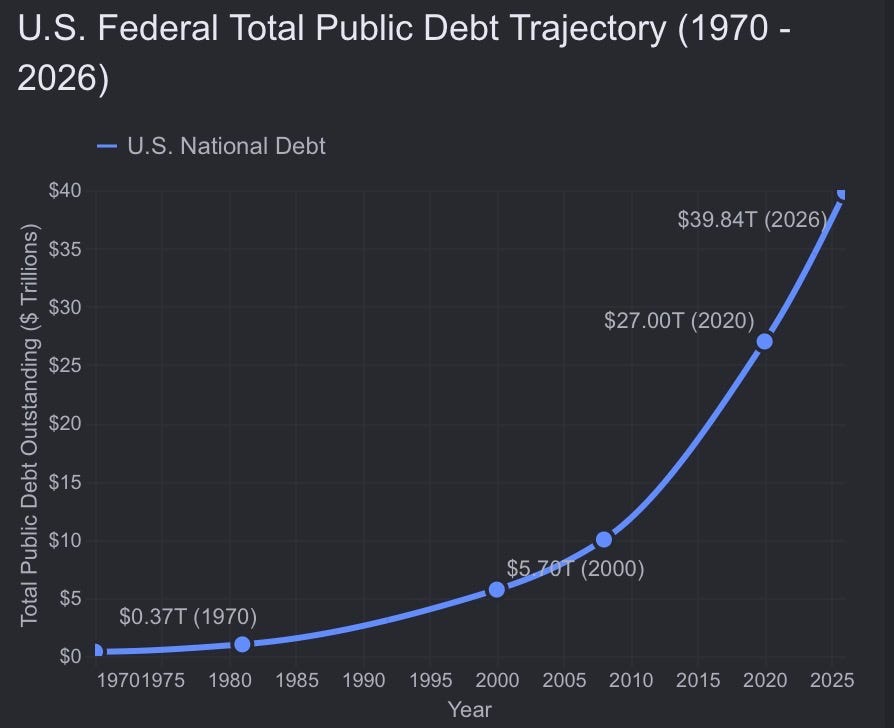
Definitions: National debt is the total cumulative amount the U.S. government owes to public and investors mostly from Treasury Bills/Bonds. The Fed balance sheet represents the central bank's total assets (mostly Treasuries and mortgage-backed securities) acquired to implement monetary policy.
Here’s the Fed’s balance sheet expansion from 2004 to today, i.e. the last 20+ years:
Here’s our US National Debt:
What I’m calling cycle #2 (2012-2020) is best defined as:
Financial Engineering Capital.
Our economic system wasn’t just being stabilized anymore. It was being amplified.
What It Created
An entire generation of founders and operators grew up believing:
capital would always be available
fundraising solved operational problems
growth outranked efficiency
interest rates would remain structurally low forever
Then COVID arrived.
Cycle #3 (2020–2022): The Pandemic Super Stimulus: $4-$5 Trillion
“The Fastest Trillion-Dollar Injection in History”
COVID triggered one of the largest and fastest economic interventions ever attempted. Governments worldwide effectively decided:
“We will freeze the economy… and replace the lost demand ourselves.”
Resulting in a historic stimulus of epic proportions.
U.S. Response Included:
CARES Act
PPP loans
direct stimulus checks
enhanced unemployment
business relief programs
additional Fed expansion
emergency liquidity programs
Approximate U.S. Totals:
Depending on methodology:
$5T–$7T+ direct and indirect support
And globally? Far higher.
This cycle can best be defined as:
Consumer Liquidity Capital.
Unlike 2008, where the stimulus went to save our banks and key enterprises “too big to fail companies,” this money went directly into households and businesses.
Consumers suddenly had:
cash
low rates
surging asset markets
Then our supply chains broke, including container ships being “stuck on the water” and Taiwan chip fab fires.
The economy overheated and inflation exploded.
The Result
We created:
the fastest hiring cycle in decades
historic wage inflation
supply chain chaos
speculative asset bubbles
crypto mania
meme stock behavior
AI funding acceleration
and eventually, the fastest rate hiking cycle in modern history, finally coming off the near-zero interest rate policies
From Google search:
Key Financial Insights
The Velocity of Borrowing: The pandemic response was unprecedented in its speed. The federal government borrowed more money in the single 12-month span of 2020 (+$4.3 trillion) than it did during the first three full years of the Great Recession combined (2008 to 2010 added $3.5 trillion). [1, 2, 3]
Debt-to-GDP Structural Shift: The 2008 crisis marked the point where the national debt began expanding rapidly compared to the economy. However, the massive 2020 spending packages pushed the total national debt to surpass 100% of the entire U.S. Gross Domestic Product (GDP) for the first time since World War II. [1, 2, 3, 4]
Long-Term Compound Effect: These consecutive crisis interventions created a permanent upward trajectory for federal borrowing. Fueled heavily by the structural deficits left behind by these packages and rising interest rates, the total national debt has grown to $39.7 trillion.
2025 - 2030: Our Next Trillion Dollar Economic Cycle: Estimate ~$7 Trillion
The AI Infrastructure Buildout; Our Modern-Day Industrial Revolution
That was a lot of “setup” and I likely buried the lede (yes, “lede” is really spelled that way — look it up!), but I felt like the history was important, and I’ve never actually written it down that way... so now I have.
This is the cycle most people are still trying to fully understand. Unlike prior cycles, this cycle isn’t about government stimulus and not driven by consumers or banks.
This cycle is best defined as:
AI Infrastructure Capital
Goldmans’s estimated $7 trillion that will be spent by 2031 now has context to our above government stimuli.
Real cash is coming from public and private companies and is being invested into:
AI data centers
GPU chips
memory chips
semiconductor fabs
energy grids
nuclear
cooling systems
networking infrastructure
sovereign AI initiatives
robotics
and all kinds of ecosystem supporting systems and services
Listening to CNBC, it seems that nearly every week companies are announcing plans to increase capital expenditures by billions.
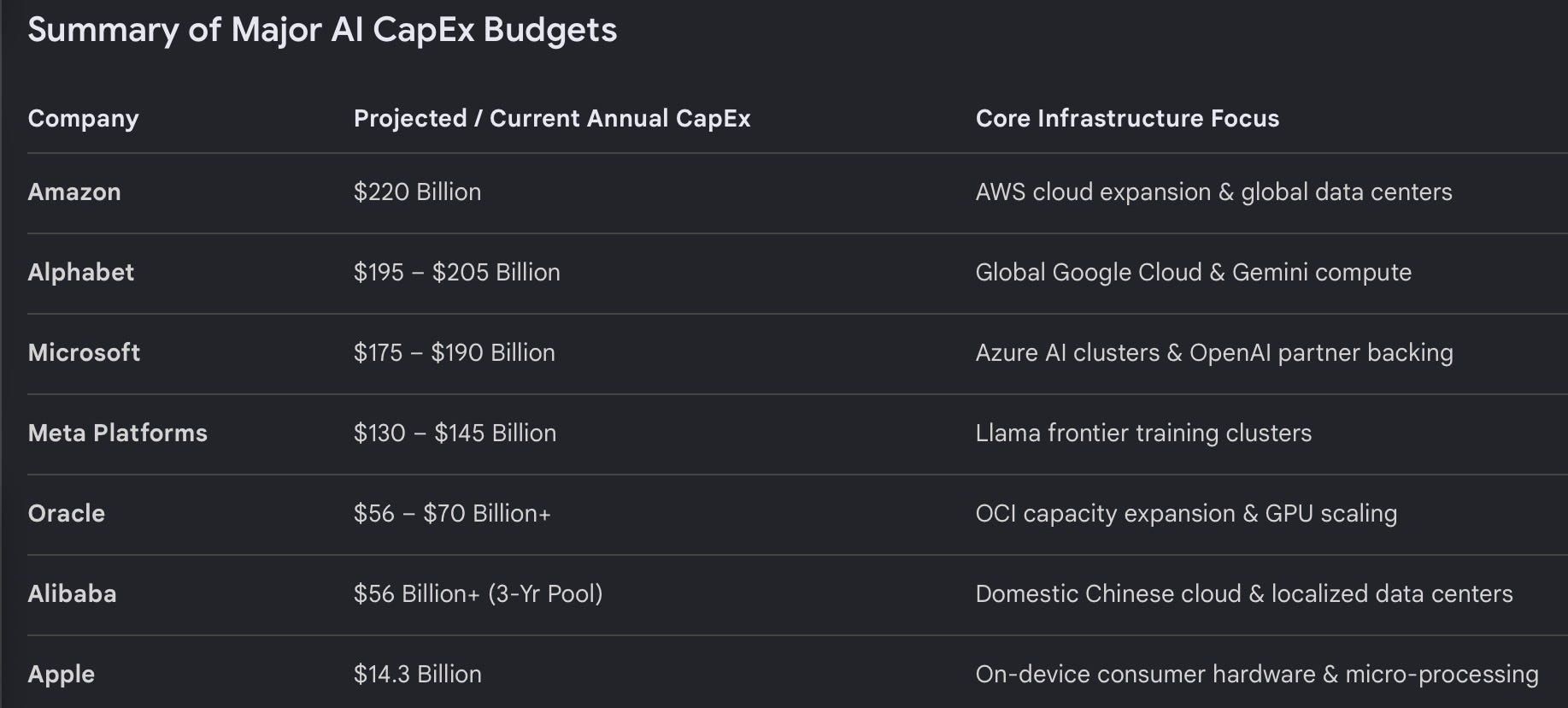
Those of you who can add fast... that’s nearly $1 trillion from just this list of 7 already committed as of today.
Here’s the point: cash is not trash in this cycle. This capital is creating actual, physical industrial manufacturing and labor demand.
Specifically, with huge investments and employment in:
construction
power generation
real estate
skilled labor
engineering
chip manufacturing
energy and water infrastructure
utilities
and many more areas including regional revitalization that supports these investments
I’m personally very bullish. If I zoom out and compare this cycle to the last 3 cycles, I believe this will become our most economically transformative cycle yet. Rather than being an “injection of cash” to “save the economy,” we are finally investing massively in real assets.
JUST IN: SpaceX’s new Terafab image has hit my “feed” since hitting publish. Here it is for perspective to bring this all together.
100 Million Sq feet…with size comparisons in the image
$16B initial build cost
Up to $120B total buildout cost (next 3-5 years)
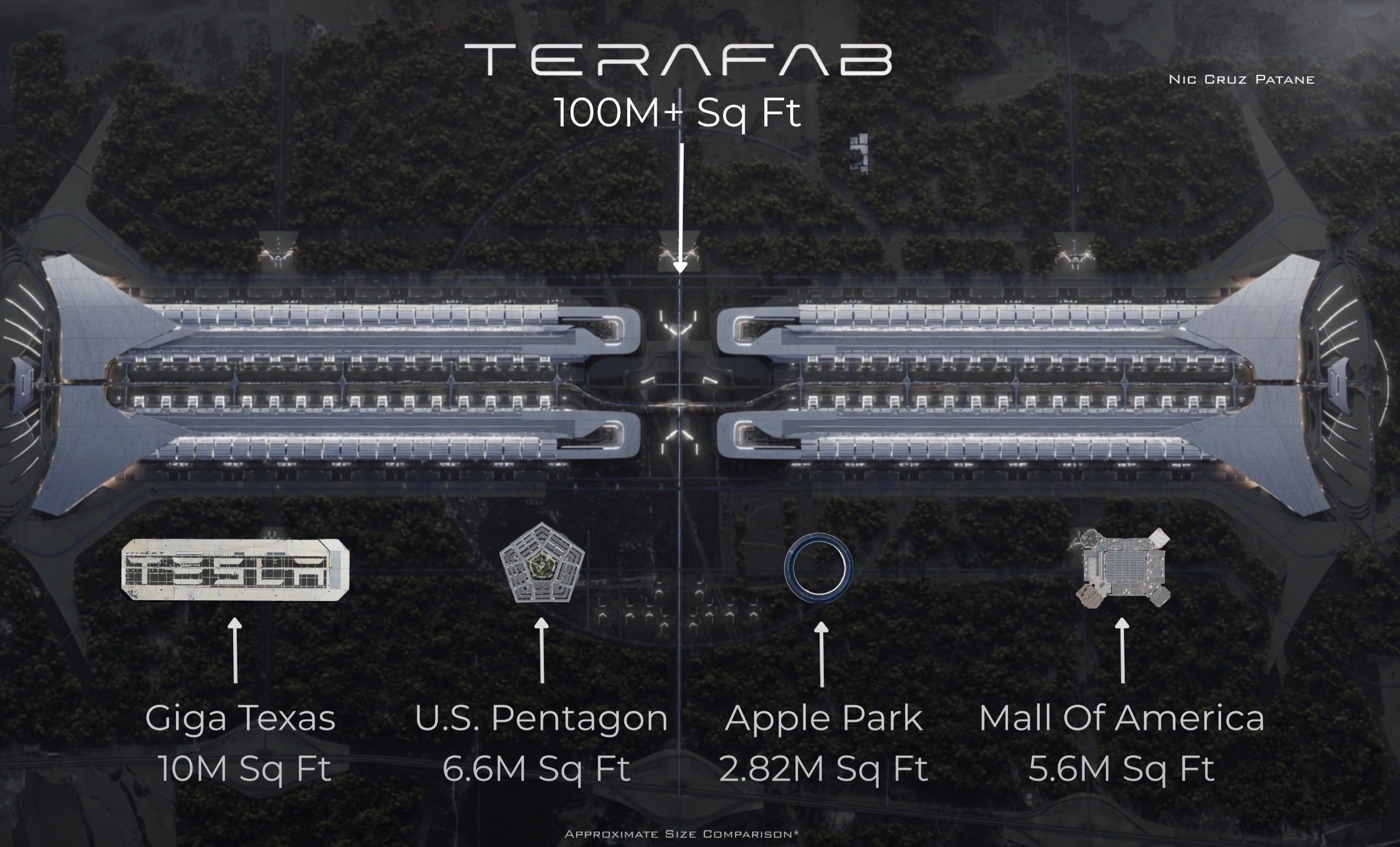
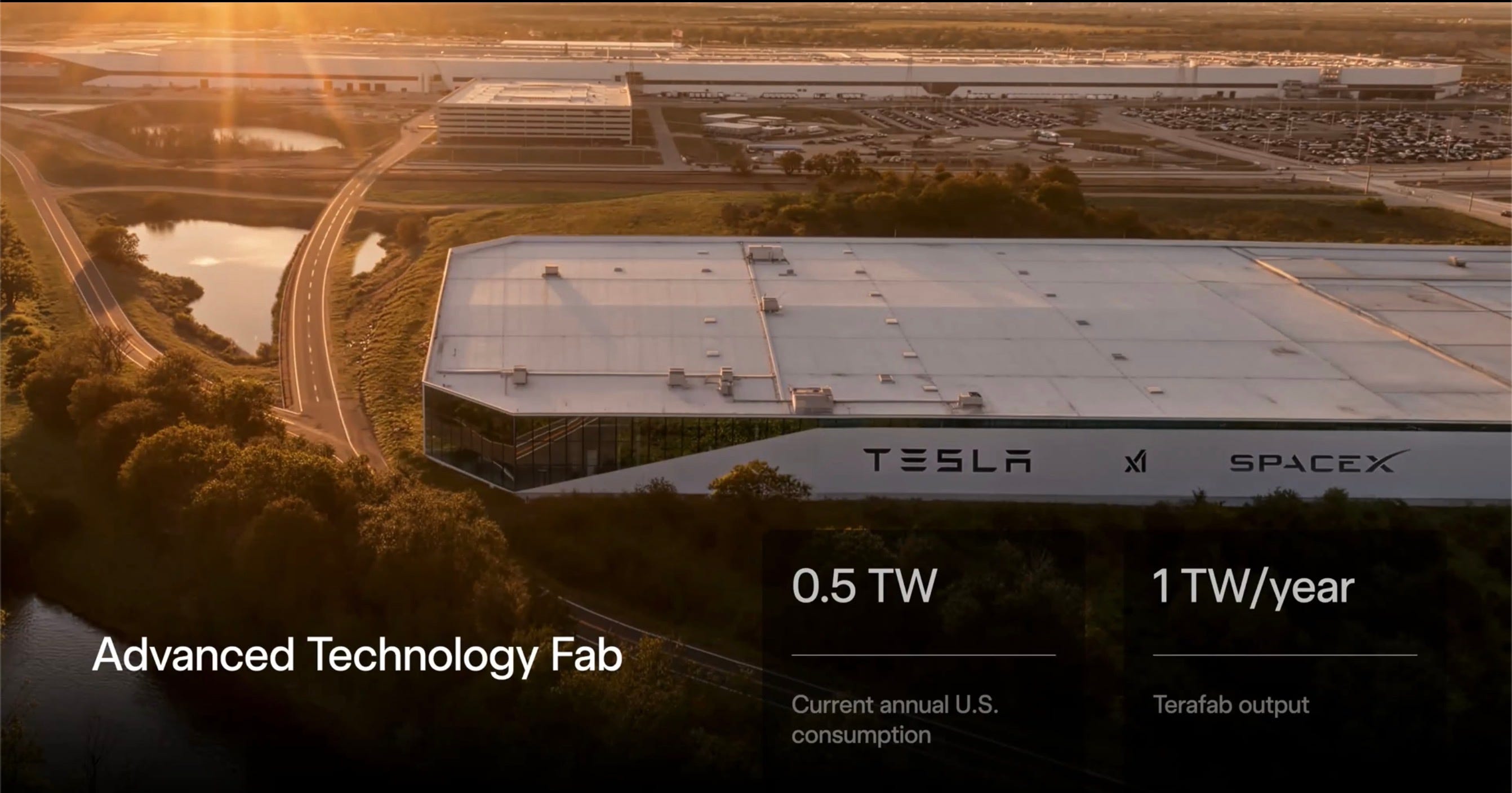
I feel it’s important to “document the assumptions” and put a marker in the ground of “this was what was said in 2026” when we look back on this post in a few years.
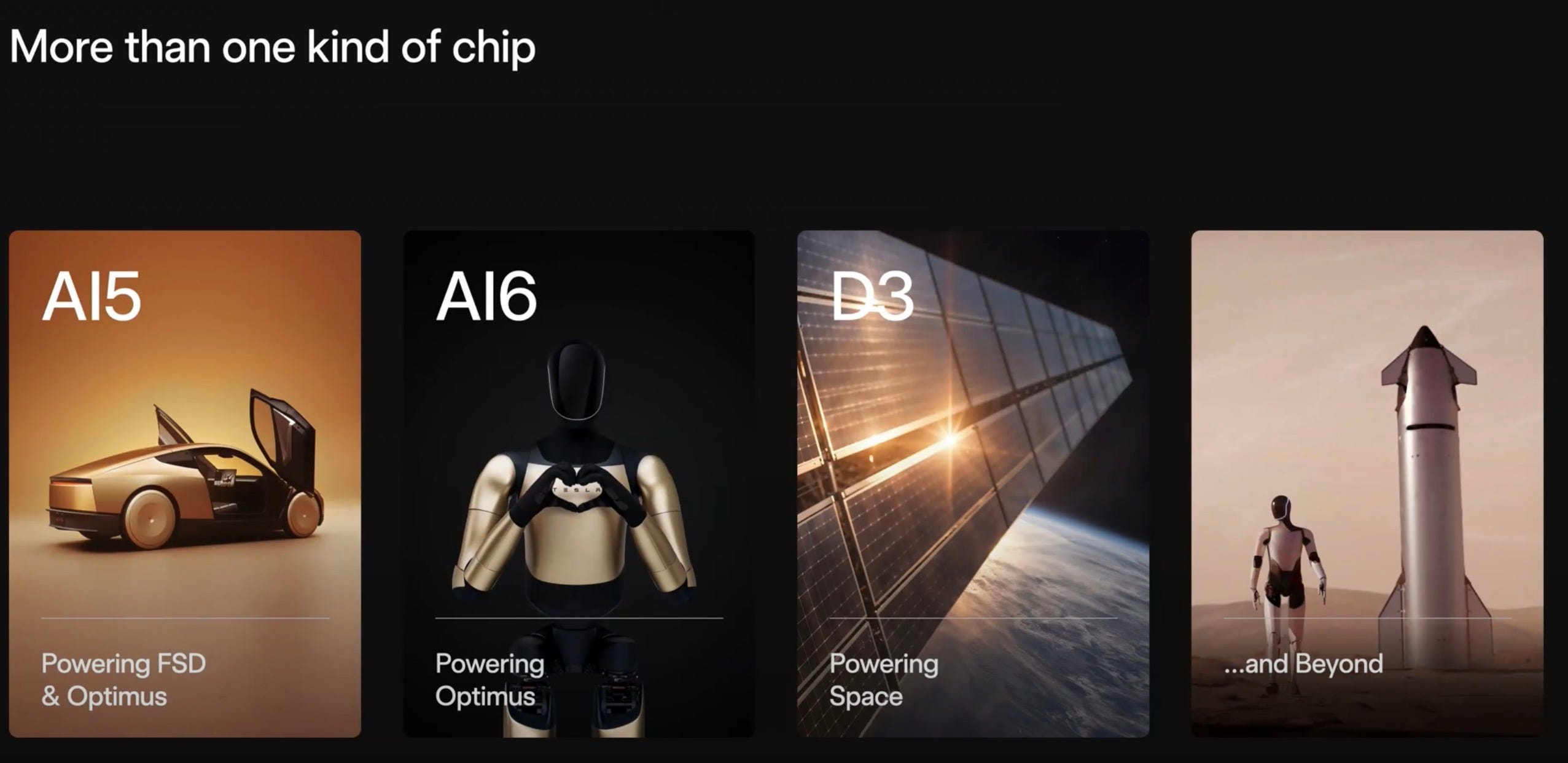
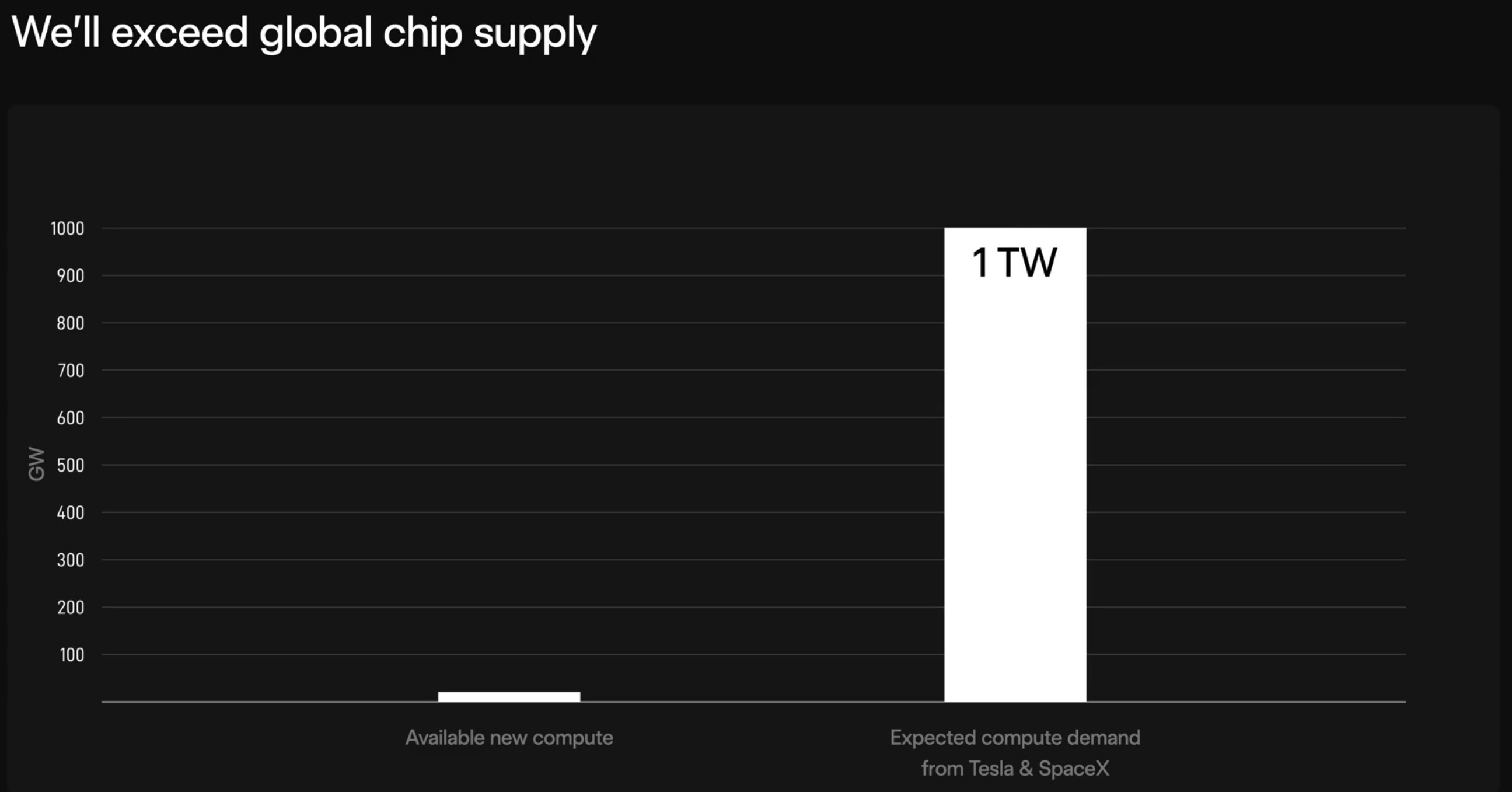
This last image is the real stunner and brings home the new investment era we are in and how far behind our future demand people like Elon and all those who invest in SpaceX and Nvidia and others think we are and what we truly need in terms of compute power.
Why This Matters for CFOs and CEOs
Let’s call the next era the AI Acceleration Capital Cycle - I repeat $7 Trillion is likely to be invested over the next 5 years on Ai infrastructure builds alone.
Trillion-dollar investments have become the new normal. They are reshaping our technology industry currently and will flow to reshaping nearly every other industry post 2030. The ripple effects and how our economy and society inflects as a result will be fascinating to watch.
When industries, companies, economies, and societies are reshaped, we must respond with new ways of thinking vs. our old ways of thinking and deciding.
The companies that succeeded during the 2012-2020 period following the housing crisis and the Great Recession made strategic bets based on the prevailing economic conditions and the era of zero-interest-rate policy (ZIRP) stimulus, while many others dismissed those conditions as unsustainable and argued they couldn't last.
During the pandemic, many naysayers argued that the world had been permanently changed and that global economies were headed for collapse. Yet within a year, in 2021, the global economy experienced one of the fastest V-shaped recoveries on record, thanks in large part to the trillions of dollars in fiscal and monetary stimulus injected into the worldwide economy. The ones who recognized this and played the new hands being dealt were the winners, while others who expected the world to go back to the “way it was” were the losers.
Today and tomorrow, we are the same “bet making” inflection point. The facts are clear. Another massive injection of “trillions of dollars” is now being invested into our economy. The buildouts will take longer (physical manufacturing and supply chain changes always take longer than fiscal stimulus) and will be healthier and more sustainable for our future.
This also means the world over the next 5 years will be different. We will have to take these facts into account for our respective long-range strategic planning, headcount planning, and our own capital investments into our companies.
We can no longer wonder whether we should start using AI Agents or whether our Engineer and Product Development departments should be using AI. We must challenge our peer leaders to “How Much AI Are You Using?” (maybe on a % basis of overall efforts), and then ask each what their % of AI will be in 6 months, 12 months, 18 months, and so on.
These assumptions must then tie back to our overall company planning and link to less headcount hired (This is wholly different than firing. I don’t believe that will happen. We just won’t hire as many new coding engineers).
We must also layer in spending on new AI-based software and agentic systems into our future plans.
A critical shift over the next few years will be adopting a new way of thinking: analyzing Return on Compute (ROC) instead of relying solely on our historical focus on Return on Investment (ROI). This is a mindset we all need to begin embracing immediately. (Next week's post will take a deeper dive into this concept.)
Specifically, this means we need a new tracking metric on “Token Economics” vs. historical “Unit Economics.”
More on all that in next week’s post.
Final Thoughts
I’m betting historians will look back at the 2000-2025 period and conclude:
The defining economic force of this 25-year era was not technology alone.
It was the repeated deployment of trillion-dollar capital cycles that continuously rewired the economy underneath us.
Technology + Capital will be our most powerful era ever.
The upcoming 2025-2050 era will be as unrecognizable as how today we wonder, “how the hell did we operate and live before PCs, Software, and Mobile Phones?” (Otherwise known as the 1950-1980s Era).
