

Value Creation vs Value Capture
Guest Post Collaboration with Alex Wu - CFO Advisors & Stanford

I’m excited to present to everyone my first guest post collaboration.
Alex Wu of CFO Advisors and the Stanford Graduate School of Business did the majority of the work here and it’s amazing. Thank you Jeff Epstein (Bessemer) for introducing us. We hit it off quickly resulting in the need to collaborate on this incredibly important startup success topic of “Value Creation” vs “Value Capture”.
Silicon Valley was born from the whole concept of Value Creation while historically struggling in Capturing the Value. Our goal is to combine both into a valuable framework for you to put into your startups practice - starting tomorrow.
EXECUTIVE SUMMARY:
Enterprise AI investment has now crossed $30 billion annually while MIT research continues to show that 95% of implementations produce no measurable return as of yet.
Nobody is arguing AI has created tremendous value in terms of productivity since it burst into the mainstream in late 2022/early 2023. The focus in early 2026 has clearly turned to AI Agents vs Generative AI as the starting point for not just being able to create or generate value but to start capturing it agentically - doing the work that humans would otherwise be doing.
The questions many boards are now starting to ask:
How much of your ARR reflects genuine product value?
Are your customers actually using your product?
Is this usage growing?
This is the gap between value creation (the original ARR purchase or Free Trial) and value capture (creating a sticky product that won’t churn in 12 months).
This may be the most under-diagnosed risk in venture-backed startups today. Not just getting companies to buy your product but getting them to use it, evangelize it to others, and happy to pay you on the next annual billing cycle.
In this playbook we’ll discuss:
The distinction between value creation and value capture, and why most startups have it backwards
How SpaceX, Netflix, and Intercom each organized around a single value creation metric
A four-step process for finding your value creation metric
Six most common failure modes
Why this is the most important yet least discussed tool in a CFO’s toolkit
The AI Success Paradox
Your AI startup feels unstoppable. Inbound leads overflow your CRM. Sales is closing enterprise deals faster than you can hire CSMs. The hockey stick you promised investors is finally here!
The board celebrates every quarter. Record revenue. Record growth. Record valuations. You close your Series B six months after your A before the bulk of customers have even reached a single renewal. You’re crushing it.
Except you start to notice some conflicting signals.
Opt-out cancellations spike at 60 days… but new logos more than compensate. Usage-based credits burn at half the projected rate and implementation timelines stretch from weeks to months. The cracks are there, but who has time to notice?
Investors don’t ask about it. They’re too busy competing to lead your next round. Internally, all these warning signs get rationalized away. After all, if revenue is growing then your product must be driving value… right?
But MIT’s recent study reveals the shocking truth: despite $30-40 billion in enterprise AI investment, 95% of implementations created no measurable return.
The researchers found that most AI pilots collapsed into “brittle workflows”: systems that couldn’t retain feedback, adapt to context, or improve over time.
Initial excitement, zero lasting impact.
These facts beg the obvious albeit uncomfortable questions:
If 95% of enterprise AI deployments aren’t working, what’s actually driving your ARR?
Are your customers buying genuine product value?
OR
Are enterprise budgets simply throwing their cash at the spaghetti wall of innovation hope in a desperate attempt to show AI progress to their own boards and make their “adoption goals”?
The two can look identical on a revenue graph, right up until renewal.
But hey, the ARR graph looks great.
Value Creation vs Value Capture
Every business does two things though we rarely talk about them this way or separate the activity motions clearly:
Creates value for customers
Captures a portion of that value as revenue
Here’s what Alex and I have witnessed time and time again in our respective careers and networks:
Most startups have a precise handle on Value Creation and almost no handle on Value Capture.
Value Creation is the actual impact you have on your customers. Solving problems, delivering convenience, expanding what’s possible. It’s imperfect, it’s messy, it’s debatable. Your product might solve multiple problems, serve different segments differently, or create value in ways you never intended. There’s no universal formula. That discomfort makes CFOs and board members search for cleaner metrics of customer engagement, customer journeys, and customer storytelling.
Value Capture is what you extract in return. Revenue, ARR, NRR, ACV. It’s perfect, it’s clean, it’s indisputable. Every investor expects these numbers, every board deck leads with them, every startup benchmarks against the same standards. For all its precision, though, value capture only measures extraction. Not whether you’ve earned it.
Most companies have this backwards. They obsess over value capture while hoping value creation happens automatically. They optimize pricing and packaging while the actual foundation erodes beneath them.
The bottom line logic is simple and one we want to strongly emphasize:
If you can’t articulate the value your product creates, your customers will struggle to justify paying for it. And without value creation, there’s nothing left to capture.
The best companies figured this out early. They built their entire operating model around a single value creation metric and let revenue follow:
SpaceX doesn’t measure success by revenue per launch. They measure cost per ton to orbit. When Musk started, that number was $50,000. Today it’s under $2,000. That 25x improvement didn’t happen by accident, it was the direct result of obsessing over reusable rockets, vertical integration, and simplified designs. The contracts, the revenue, and the valuation are all downstream of that one number.
Netflix obsesses over hours watched, now over 2 billion daily worldwide. That single metric pushed them toward binge-worthy originals, personalized recommendations, and seamless device switching. Crucially, when engagement drops, they see value destruction happening in real time, long before it ever shows up in subscriber numbers.
Intercom could measure seats sold or messages sent. Instead they track support cases resolved and time to resolution. Every major product decision from automated workflows, AI-powered responses, to proactive help features flows from that metric. The revenue follows because the outcome is real.
Pricing, packaging, and expansion are all levers you pull to capture value. But they only work if the value is actually there.
Like Newton’s laws of physics, this is a foundational law in business: in the long run, value capture cannot exceed value creation. You can extract more than you create for a while through pricing power, switching costs, or investor subsidies. But the gap always closes.
As I have said many times, “Mind the Gap!”
Customers will find the alternative. Competitors who create more value will take more share. The startups that confused a rising tide of enterprise AI budgets for product-market fit discover, at renewal, that their product value is built on sand.
Finding Your North Star: How to Measure Value Creation
So how do you actually find it? Most founders overcomplicate this. They convene offsite workshops, hire consultants, build dashboards with dozens of KPIs, and still can’t answer the basic question: what changes in your customer’s world when your product works? What stories do your customers tell about your product?
I just wrote a post on building a Customer Operating System to answer just such questions.
Below is our suggested four-step process. If you can answer all four honestly, you’ll have your metric. If you can’t, you’ll know exactly where the gap is.
Step 1: Name the Job
What is your customer hiring your product to do?
Not what your product does. What changes in your customer’s life when it works.
The job should be stable even if your product disappears tomorrow. Someone else would still need to get it done.
Intercom’s customers aren’t hiring a “messaging platform.” They’re hiring Intercom to make customer problems go away quickly. The job exists whether Intercom exists or not.
Step 2 : Define Done
How does your customer know the job is complete?
What would your customer measure, even informally, to know this worked?
The answer should be something they’d track even if they weren’t paying you.
Beware activity-based metrics. “They logged in”. HINT: MAUs is not DONE!
A support leader doesn’t celebrate messages sent or tickets opened.
They celebrate cases resolved. That’s the finish line.
Step 3: Identify the Unit of Value
What is the smallest discrete outcome your product delivers that the customer would pay for one more of?
Strip away packaging, pricing tiers, and bundled features. What is the single indivisible unit of value?
For SpaceX it’s a kilogram delivered to orbit. For Netflix it’s an hour of attention held. For a payroll company it’s an employee paid correctly and on time.
The unit is a resolved support case. Not a seat. Not a message. Not a conversation started.
A case that ended with the customer’s problem actually solved.
Step 4: Stress-Test Your Metric
Can this metric be gamed, inflated, or improved while the customer gets worse off?
The customer test: Would your customer independently celebrate if this number improved? If only your team cares, it’s an internal metric, not a value metric.
The corruption test: Could this number go up while the customer experience goes down? If yes, you have the wrong metric. (Example: “bot deflection rate” can hit 80% by looping customers through help articles that never actually solve the problem.)
“Messages sent” fails the corruption test immediately. More messages could mean worse support, not better.
“Cases resolved” passes: if that number goes up and resolution time goes down, customers are unambiguously better off.
The Six Ways Founders Get This Wrong
Defaulting to revenue. Revenue is a lagging indicator that can mask value destruction for quarters before it surfaces.
Choosing vanity or “activity” metrics. Total registered users. App downloads. Reports generated. These look impressive and say nothing about whether a customer’s life improved. The tell: a metric that goes up regardless of whether the product is working.
Confusing your output with their outcome. Features shipped, tickets closed, emails sent. These measure what your company produced, not what your customer experienced. If only your team celebrates when the number goes up, it’s the wrong metric.
Making it too complicated. If your team can’t remember the metric or explain it to a new hire, it will quietly stop influencing decisions. Complexity is how north stars die in practice.
Picking something you can’t influence. A metric too far downstream from daily decisions creates learned helplessness. The metric should feel one level out of reach, ambitious but traceable back to daily work.
Never updating it. The mistake isn’t changing your value metric as the business evolves. The mistake is pretending it still works when it doesn’t. The right metric at seed stage can become actively misleading at Series B.
The Metric That Matters
Most companies just chase revenue as their north star metric, and 90% of them still fail. The generational breakouts chase something different: a single measure of value creation that captures whether their product is actually changing the customer’s world.
SpaceX bent the cost curve of space access. Netflix reshaped how two billion hours of human attention get spent every day. Neither happened by accident. Each company identified its value creation metric early and organized every operational decision around inflecting it.
This is perhaps the most important and least discussed tool in a CFO’s toolkit.
Value creation doesn’t show up on a P&L. It’s messy, imperfect, and endlessly debatable. That’s exactly why most finance leaders avoid it. But the founders and CFOs who find their value creation metric and organize the entire company around inflecting it build businesses where retention, expansion, and pricing power all become downstream consequences of a problem being solved. Revenue stops being something you chase and starts becoming something that’s inevitable.
Here’s a great quote from a recent panel talk Roelof just gave on this subject:
“Value delivery should come before value capture, and entrepreneurs should focus on creating something useful before thinking about the business side of things.” — Roelof Botha - Sequoia Capital
Roelof had several observations during his talk that illuminate the tension between value creation and capture, especially in early vs later stages.
In the podcast “Sequoia’s Crucible Moment”, Botha emphasizes that in the early days of a startup, there needs to be heavier weight on value creation over value capture. Build something compelling; make something people want so badly they can’t stop using it. Without that, value capture strategies (pricing, monetization) will be hollow.
He warns against premature monetization or over-focus on capturing margin before the product and customer foundation is strong. Early capture can undercut growth, reduce user adoption, and limit the size of the pie. (This emerges in his commentary about startups tempted to chase metrics or revenue too early rather than product/market fit.)
He also stresses long term value creation as a discipline - not just in features or product, but in culture, operating metrics, durability. From his position, a start-up that scales to be one of the “500 most valuable technology companies” is not just one with strong value capture; it’s got to have enduring value creation that customers, markets, ecosystems love.
Scaling Trade-offs
Here are typical trade-offs and how a company should evolve its balance of value creation vs value capture:
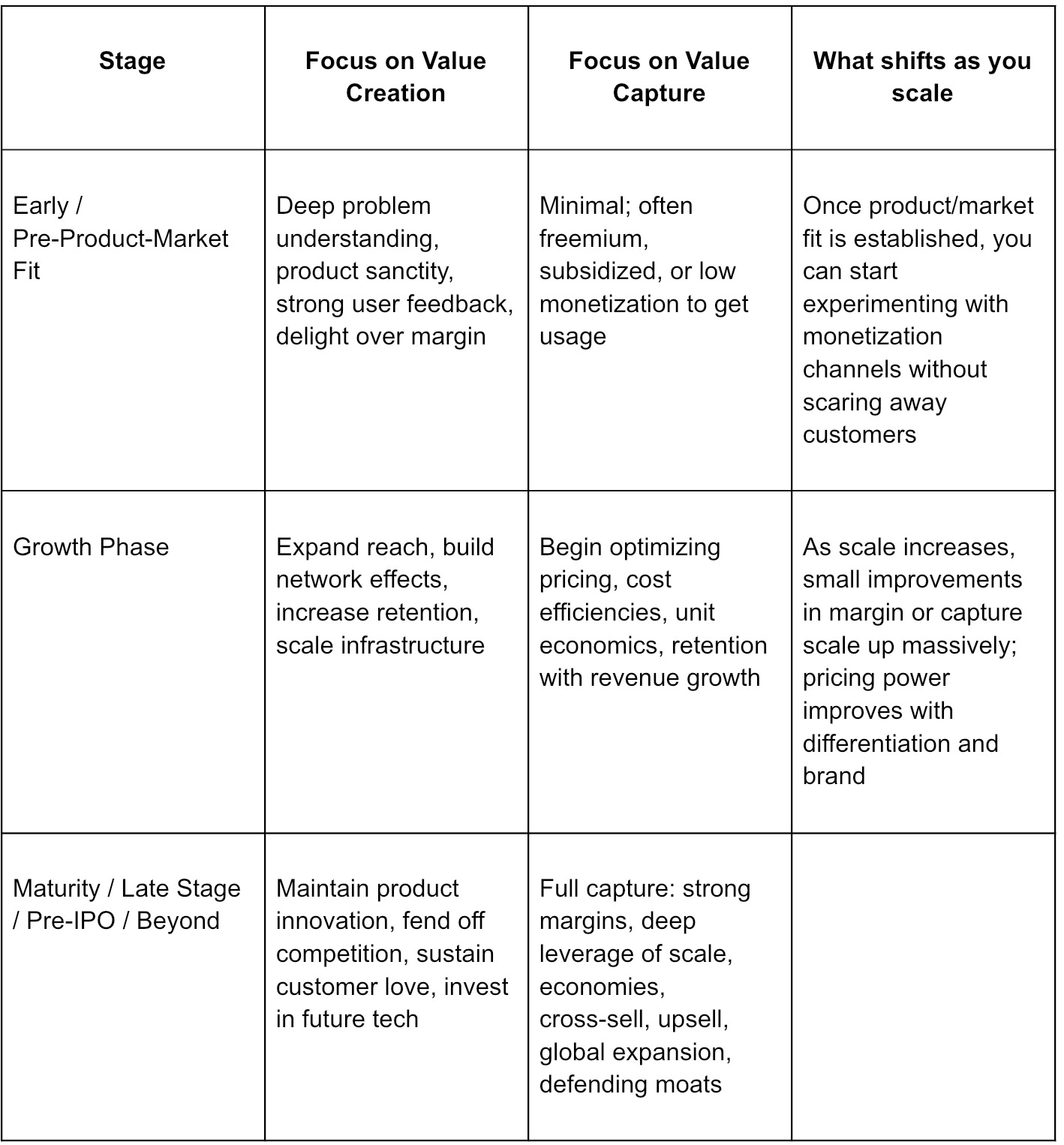
Common Failure Modes
Value creation without capture: you build something people love (or large usage) but your business model is weak, margins are negative with no clear path. Often seen in high burn, low conversion, or when costs don’t scale with usage.
Value capture without value creation: early monetization can drive revenue but if the product doesn’t retain customers, or usage drops, or competitive substitutes emerge, it unravels. Think hard about what you deliver.
Over-optimizing capture at the expense of creation leads to incremental improvements rather than breakthrough innovation; you may win short term but lose long term.
Misaligned incentives inside the company (e.g. a sales-driven culture pushing pricing up even though product defects or customer dissatisfaction are ignored) that degrade value creation.
Framework for Founders / CFOs / COOs
To operationalize the balance, here are tools and questions:
1. Map the value creation levers: What are the biggest contributors to creating value (product features, service quality, user experience, data, network effects)?
2. Map the value capture levers: What are your monetization & cost levers? Pricing, tiering, margins, cost of acquisition, churn, upsell/cross-sell.
3. Measure unit economics early: even when revenue is small, understand the cost to serve, lifetime value (LTV), churn & retention. These indicate whether capture is viable.
4. Run scenarios of scaling: what happens if you double users but halve monetization per user? Or if you raise prices / shrink features? What are the elasticity & risk trade-offs?
5. Align culture and incentives: reward value creation early (product, engineering, customer success) as well as capture later (sales, finance).
Conclusion
Scaling to a billion-dollar company is not just about aggressive monetization or fundraising. It’s a dance between creating something deeply valuable, and capturing enough of that value to sustain growth, fund the team, creating investor returns, and funding future moats.
Founders who understand when to balance Value Creation and Value Capture are the ones who build legendary companies.
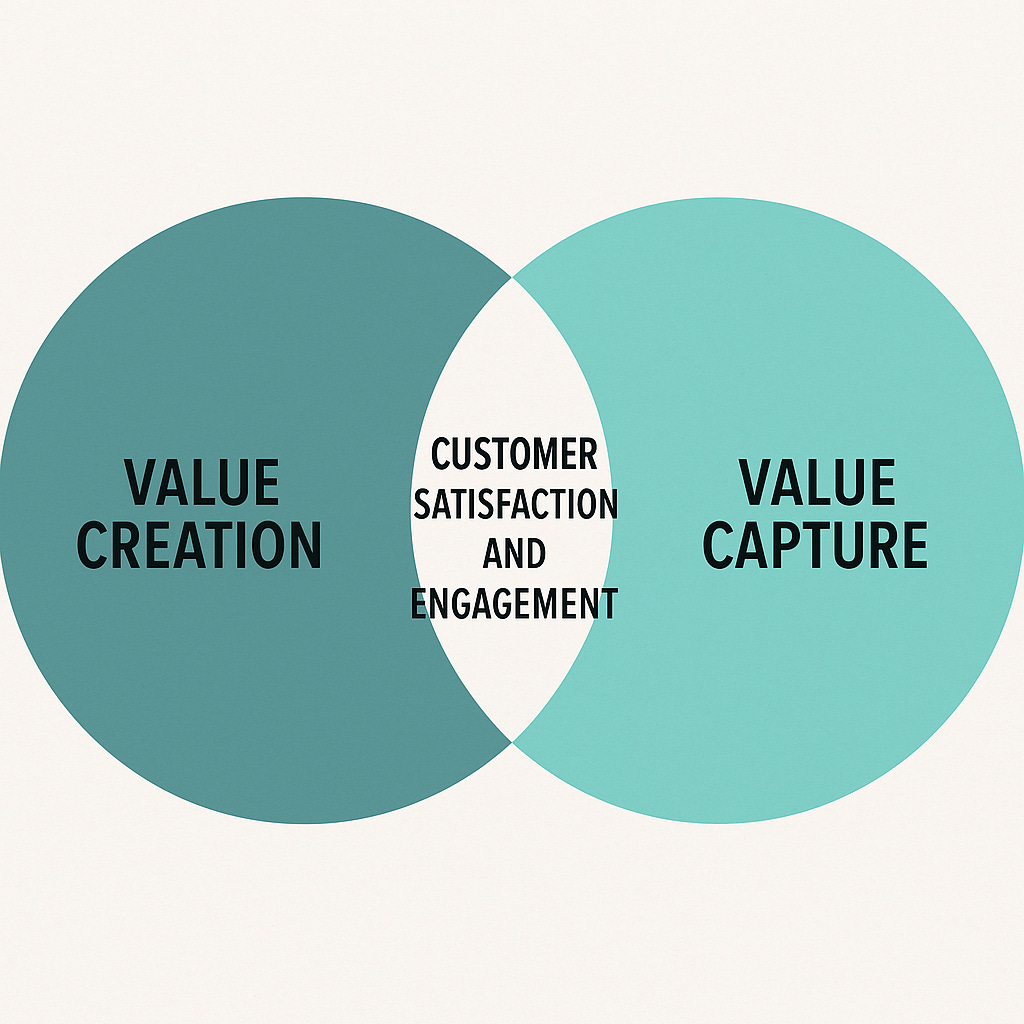
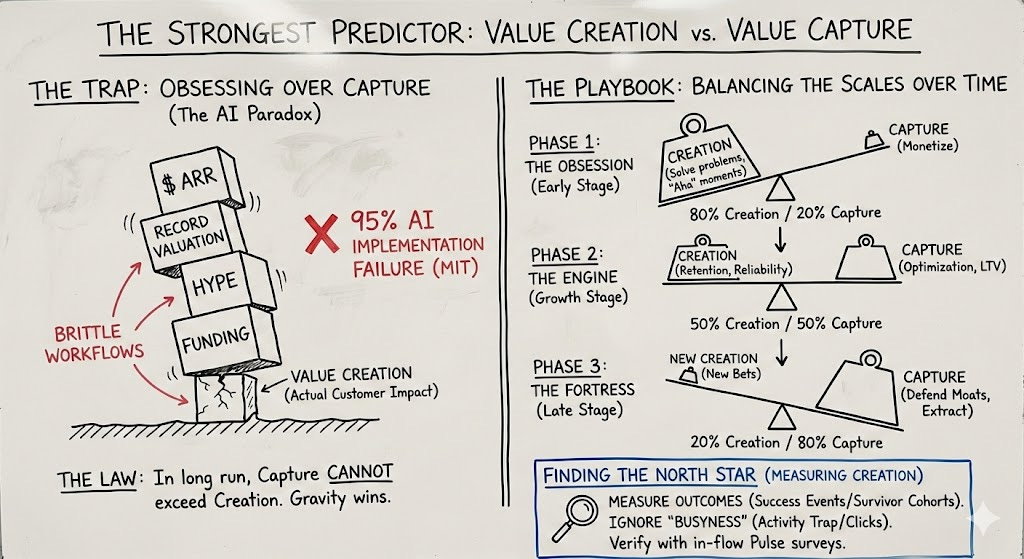
Alex and I also played with AI to create this graphic for this post if you want to use it in your next exec staff or all hands offsite.
If you want to bring either of us or both of us in to speak to your company more deeply on this subject, we are simple LinkedIn message away.
