

CFOs as Chief Architects
AI in Finance? Where Do I Start? Fix Your Finance Stack First!


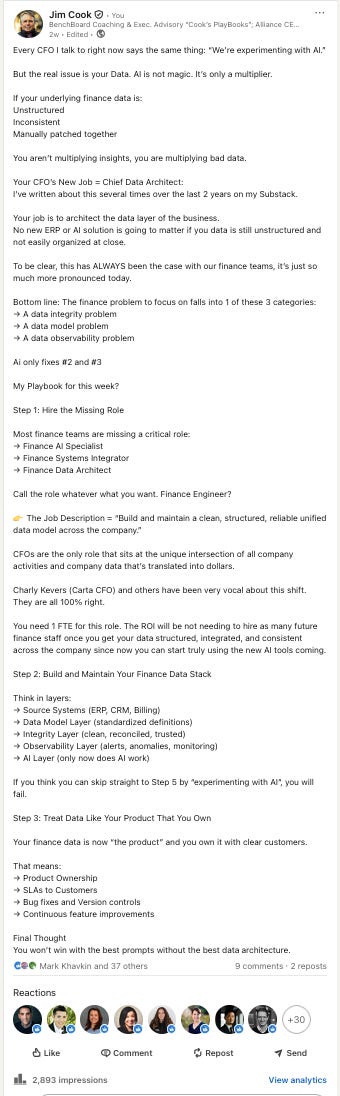
2 weeks ago I posted the following on LinkedIn. It quickly received nearly 3,000 impressions. Suffice it to say it hit a chord. So, I’m going to expand on this concept here on Substack.
Easter Egg: there’s entertainment in this post… don’t miss the Monty Python and Eminem videos. Who says finance is boring!
I’ve been writing on this consistent theme for awhile here on Substack. Here are some of my previous posts on this subject:


THE WRONG QUESTIONS; FIX YOUR FINANCE STACK FIRST
Every CFO I know is asking some version of the same wrong questions right now:
“Where do I get started with AI in my finance team?”
“What should my AI strategy be for finance?”
The real problem is not where or how to start with AI.
The real problem is to make sure you have the proper data structure before you even think about applying AI to it.
Let me guess. Your finance and overall company data is still too fragmented, unstructured, mislabeled, delayed, or manually patched together. The data you need is still trapped across disconnected systems.
Adding AI on top of that? OOF! Welcome to AI giving you bad answers faster with it’s classic hallucinatory confidence, telling you how smart you are… all with awesome formatting!
So let me say this clearly again: There are 3 main problems in finance and company data today:
Data Model Problems (ie - not actually having the right “data model”)
Data Integrity Problems (ie - not syncing data consistently and accurately into your data model)
Data Observability Problems (ie - not mapping where the data lives so you can extract it into your data model)
Start Up There ^^^^……. Hard Stop.
CFO as Chief Data Officer as Chief Architect
The next generation of great CFOs will need to put on their best Chief Product Officer Hat.
The best Chief Product Officers I know do the following things very consistently:
Create clear roadmaps of their customer’s journey
Focus relentlessly on customer requirements
Define those into key product feature requirements
Design simple, structured product steps to “aha moments”
Innovate, measure, and course correct or “experiment, track, and refine”
For CFOs, start thinking of your finance teams data as your “Product”.
You are the owner of this product and you need to focus relentlessly on your “Customer”.
So don’t fall into the FOMO trap of experimenting with AI by running pilots, demos, and experiments against data that was never structured to support machine learning in the first place.
Your new demo might look impressive for the first ten minutes. But look out below when you double click or your CEO or Board asks the next level question.
Your awesome AI now failed. Actually it wasn’t your AI… it was your data architecture.
CFO As Architect
This is where your role and your mindset now has to change.
We CFOs have been historically asked to own the outputs of numbers. To close the books, to forecast the future based on the close, to prepare the board deck to communicate both the actuals and the plan, to track variances, and to be the safeguarder of company assets.
That’s all still true but not enough for the future CFO.
You are now no longer the CFOs who say ERP!
You are now the architects who say “AI” (for bonus points pronounce the “I” as “eee” to match Monty Python below!
The best future CFOs will now have to own the information architecture behind these outputs.
Architects ask different classes of questions:
Where does this number originate?
What system owns the truth?
Which definitions are standardized and which are tribal knowledge?
Where does my staff “fix” the data manually each month?
Which sets of data insights are actually reusable data products versus one-off spreadsheet heroics?
What context and assumptions should accompany the raw data?
Yes, you have to quickly layer AI on top of your data architecture. But AI needs to be at the tail end of the Strategy > Structure > Execution loop.
Your data design and your data model are your strategy and structure, and they must come first before you layer on AI to execute.
So let’s get down to specific steps to make this happen.
Step 1: Hire a data engineer onto your finance team
All great Product Managers partner or hire an engineer on their staff.
It’s time for you as the Chief Product Manager of Finance to hire this engineer on your team.
Call the role whatever you want:
Finance AI Specialist
Finance Systems Integrator
Finance Data Architect
Finance Engineering Lead
I care less about the title and more about the vision and mission.
I’ve laid out the vision above. Your mission (if you choose to accept it) is to architect the finance data environment so that the AI machines can actually be useful.

The person in your new role is not there to build vanity dashboards or to simply automate the manual. This new role needs to design and build the foundation of your future finance team value:
Map the data model
Define system ownership
Clean up broken data flows
Create structured context across disconnected systems
Reduce manual interventions and reconciliations
Design the connective tissue across ERP, CRM, billing, payroll, HRIS, procurement, data warehouse, and planning systems
Build the cross checks to make sure your new data model stays clean and connected over time, not just every time you go to clean it up
Hint: You may need more than 1 role for this function and you must now start rationalizing the ROI of such roles or you and your team will be architected out of the value such data and insights created by somebody else in the org.
Step 2: Build and Maintain Your Finance Data Stack
Think in layers:
Layer 1: Source Systems (ERP, CRM, Billing)
Layer 2: Data Model Layer (standardized definitions)
Layer 3: Integrity Layer (clean, reconciled, trusted)
Layer 4: Observability Layer (alerts, anomalies, monitoring)
Layer 5: AI Layer (only now does AI work)
Step 3: Act Like the Product Owner You Now Are
Your finance data is now “the product” and you own it with clear customers.
That means:
SLAs to Customers
Bug fixes and Version controls
Continuous feature improvements
Customer Listening Tours
3 Root Cause Failures:
It’s critically important to predict root cause failure analysis. All great operators and product managers think to the future in order to work backwards to today. And they think in terms of success and failure at each point in time. So if the above was all about how to succeed, the below will be your warning signs for failure and where specifically to look for the weakest chains in your new data model architecture.
In the end, most AI failures inside finance trace back to one of the three root causes:
1. A data model problem
This means the information itself is not structured well enough to support reliable output.
Where to look:
Inconsistent chart of accounts mapping
Revenue definitions changing by team
Fragmented contract data (data context living in multiple systems or the context doesn’t “live” at all and was never captured)
Inconsistent time periods or naming conventions
Weak dimensional modeling in your data warehouse
As I write the above, I’m now thinking to myself that AI could possibly be used to uncover the anomalies above?
2. A Data Integrity Problem
Poor master data hygiene
Customer records that do not reconcile across systems
Missing contextual metadata (key assumptions, relational data)
Manually maintained spreadsheets acting as shadow systems
3. A Data Observability Problem
This means the data may exist, but you cannot reliably monitor, trust, or explain what is happening to it over time.
Examples:
Broken pipelines nobody notices for days
Silent field changes upstream
Delayed refreshes
Unexplained metric movements
Failed syncs between systems
No alerts when data quality degrades
No audit trail for how a number changed
No confidence scoring on inputs
In this case, the issue is not merely that data is messy.
The issue is that the mess is invisible until a board meeting, a forecast miss, or an audit surprise forces it into the light.
Please, please, please never forget and always remember:
Trust in finance is built not just on correct numbers.
It is built on 3 pillars:
Accuracy
Consistency
Timeliness
While Confidence and Credibility is built on:
The Insights and Value Add You Bring to the Numbers
Build a Finance MCP for Proper Data Context
AI does not only need properly structured data. It needs context.
It needs structured access to how your business defines customers, contracts, revenue recognition logic, headcount categories, departmental ownership, approval rules, scenario assumptions, historical exceptions, and policy boundaries.
To make this crystal clear: “Data Tables” are awesome but tables are NOT CONTEXT!
Excel rows don’t product reasoning.
Capturing insights is not truly understanding.
You need to build a clean context layer across your finance data and systems so that the AI can retrieve the right definitions, relationships, and rules in the right way at the right time.
The headline here?
The Future Finance Stack Is Not a New System of Record.
It’s a System of Context.
You must design and build context into your data architecture.
Maintain the context. Provide access controls.
You must be able to drill down and eliminate any AI hallucinations or confidence masking the inaccuracy it might produce.
The future finance stack must be able to use Layer 5 (AI) to produce the Accurate, Consistent, and Timely Data of which we speak!
As Eminem so classically rapped, “This is your moment… you own it!” Your leadership moment. Your systems moment. “You get one shot. You better never let it go. Once in a lifetime.”
The future CFO will architect the company’s financial intelligence layer.
5 questions every CFO should ask right now.
If I were sitting in your seat this quarter, I would start here:
