How To Size Risk vs. Reward
The Decision Systems I Used as CFO

As our 1st Quarter Ends, your 2026 Operating Plan is well underway.
If you are one of my CFO Readers, you will want to keep this playbook. If you are another C-Level Exec or a VP or Director trying to influence one, I recommend you talk to your CFO about using some of the techniques and language below.
Let’s start with a key thought model on decision making - the decisions that created your plan and the decisions you now need to make as a result of your 1st quarter’s plan vs actuals:
“Good decisions aren’t about certainty. They’re about confidence, clarity, and the ability to course-correct the decision.”
Every operator I’ve ever coached - CEO/founder, COO, or CFO have all eventually hit the same wall. I absolutely hit this wall early in my career.
We don’t have a consistent way to properly size the downside of risk vs the upside of reward.
So we rely on our instincts, experience, opinions, or we manipulate the data to support our internal biases.
We lack a repeatable system to evaluate the trade-offs that truly determines the quality of our decisions.
Today’s post goes deep into how I’ve learned to size risk vs. reward using the core components of the Decision Making Series I wrote about over a year ago.
My readers know I’ve been working on these frameworks and playbooks as I try to communicate and influence how to be a better decision maker. I’ve introduced concepts such as the Risk Equation, Confidence Scoring, and the Powerful Questions Framework.
After 30 years operating inside Intuit, Netflix, and Mozilla, and now coaching dozens of CFOs and founders, I can confidently say:
CFOs need to learn to influence more. Influence requires their ability to quantify and plan for uncertainty and to communicate this ability effectively.
In order to consistently influence and establish high credibility, I recommend communicating to your peers in the form of a “decision system”.
Let’s unpack some of my own consistent coaching on “decision systems”:
1. Decision Quality = Understanding the Range of Outcomes
Don’t make decisions based on a single predicted outcome. I used to do this early in my career. Our revenue plan is $X. Our cash at the end of the year will be $Y. Then you learn you will never be 100% accurate of X or Y, leaving you to have to explain a variance on why the numbers weren’t X or Y.
Then you learn that wasn’t the point at all. A range of X and a range of Y was good enough to determine success. Below that range was bad and above that range was good.
So start make decisions based on ranges of outcomes… not X or Y.
Best Case
Base Case
Worst Case
Or
Minimum
Expected Value
Maximum
Take your pick, but that’s only the starting point.
The key is to attach specific assumptions, key metrics, and critical timelines to each case.
2. This is where the Risk Equation enters the system
Risk = Probability × Severity
I’ve seen seasoned leaders focus only on the severity part of the equation on both ends of the severity spectrum.
“Even if this is bad, how bad could this be?”
“Wow, the bad outcome could kill us.”
Great operators don’t focus on these extremes of severity. Neither are useful without equally focusing on the probability of the severity.
Probability Analysis is critical in decision making. Example:
“There’s a 1 in 1,000,000 chance the outcome that kills us happens.”
Or
There’s a 1 out of 2 chance (50% probability) of the negative outcome that, while not very severe, will significantly slow us down and set us back.
Elite Operators? They also add Frequency of the Probability to the mix. The 1 in a million chance that only is capable of happening every 10 years is very different from the 1 in 10 chance of a bad outcome whose potential frequency is daily/weekly/monthly.
Here’s my Risk Matrix
To size decisions intelligently and to help influence the room of the “true risk”, I will pull out a simple 2×2 matrix learned from my time with my Security and DevOps teams of the past.
Axis 1: Severity of Risk
(Low → High)
Axis 2: Probability of Risk
(Low → High)
Note: I’ve included the optional Frequency into the Probability axis, since a more frequent chance of risk increases its probability of occurring.
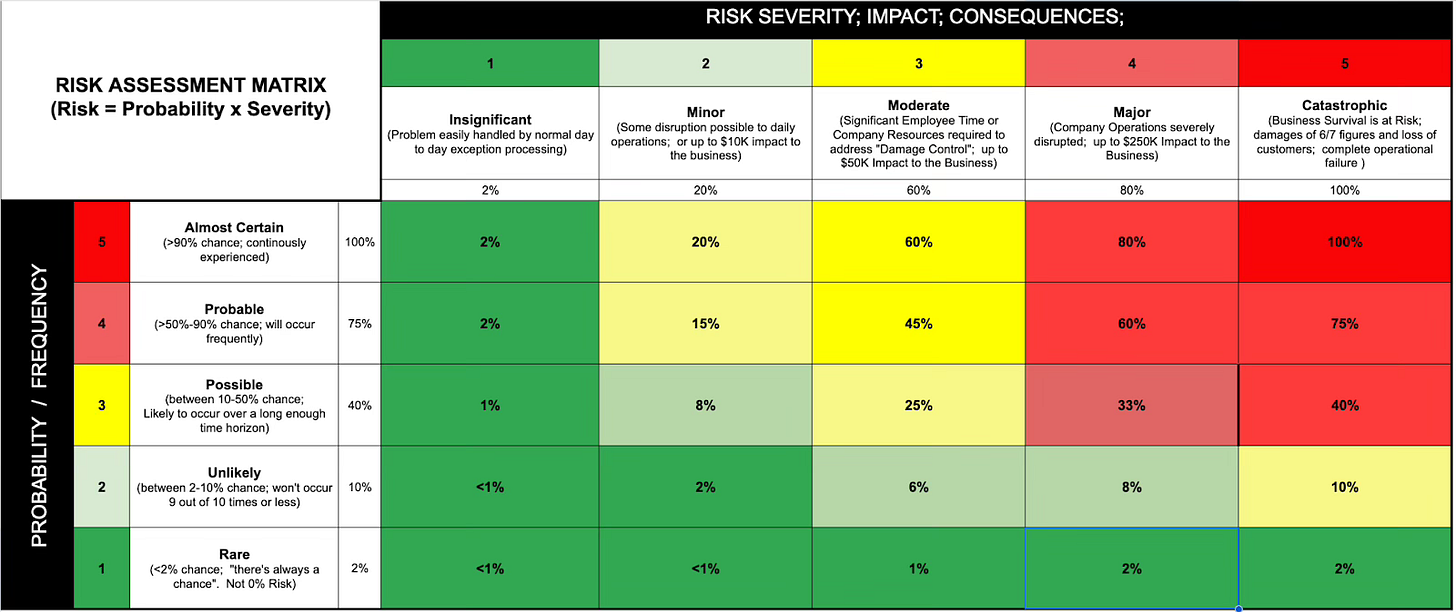
Low Severity / Low Probability
Green Light
Your job? Move fast. Execute cleanly. Remove friction.
These are the “don’t overthink it” decisions.
Quadrant 2: High Severity / High Probability
Red Light
This is where capacity planning, cash runway, and execution sequencing matter most.
3. Bringing Confidence Scores Into the System
One of the most powerful habits you can develop—as a CFO, COO, or CEO—is tagging every assumption with a confidence score.
I use a simple scale:
High Confidence (70–100%): Supported by data, customer evidence, or repeated patterns
Medium (40–70%): Directionally informed but incomplete
Low (<40%): Opinion, hypothesis, or early signal
Now combine this with your risk–reward matrix:
High Risk/Reward decisions with low-confidence assumptions deserve caution, not enthusiasm.
Low Risk/Reward decisions with low-confidence assumptions deserve to die immediately. These decisions either aren’t really “decisions” or even if you succeed in something low reward with low risk… you are likely to ask “So What?”
Confidence scoring forces intellectual honesty.
It forces personal beliefs into a score (a.k.a “data”).
Teams stop arguing opinions and start comparing assumptions.
4. The 5 Powerful Questions That Size Risk Properly
Here are five questions to either include in an executive/board briefing or to ask depending on what seat/role you are in.
1. What must be true for the upside to happen?
List the assumptions. Score their confidence.
2. What is the cost of being wrong?
Financial, operational, reputational.
3. What is the earliest signal that tells us we’re wrong?
Pre-mortem thinking. And when will we first see this signal?
4. How reversible is the decision?
The Bezos “one-way vs two-way door” thinking.
5. What is our cheap test?
Every big decision can and should be tested with a small, fast, low cost experiment to prove the underlying assumptions.
Just asking these five questions will elevate your decision quality by 2-3x. Keep asking powerful questions and you can compound your decision quality even more.
Let’s also Size the Risk: Here are 4 categories to score:
Financial Risk
Cash burn, capex, margin impact, downtime.Execution Risk
Sequence, velocity, team capacity, cross-functional complexity.Customer Risk
Retention, experience, support burden, product-market fit.Reputation Risk
Brand trust, board confidence, stakeholder alignment.
Elite CFOs score all four. How many is your team scoring?
Now let’s talk about the REWARD side of the house. Risk is so negative after all!
Sizing Reward: Start With Strategic Fit
Many startup execs and teams mistakenly judge reward by financial upside alone.
Bad idea.
The best evaluate reward across five dimensions:
Strategic Alignment
(Does it support our strategy, structure, and execution system?)Financial Impact
(Revenue, margin, cost savings, cash runway)Customer Impact
(Does it improve the customer journey or customer community experience?)Organizational Impact
(Does it improve or strain team capacity, hiring, or leadership bandwidth?)Long-Term Advantage
(Does it build a moat? Capability? Optionality?)
This is where 90% of decisions go wrong.
The reward is not aligned to the strategy. Hard stop.
Bright shiny objects often become the exciting but silent killers of focus and execution.
Summary of My Decision System:
1. Write Down The Decision We’re Making
Make it clear, simple, specific, measurable with documented assumptions. It’s amazing what “Writing It Down” does for clarity.
2. Communicate Your Clear Strategic Thesis for Making the Decision
Your point of view. Your narrative. Your 1st Principles. The “Why”.
3. The Reward (Sized)
Strategic, financial, customer, organizational, long-term.
4. The Risks (Sized)
Probability × Severity + Confidence Scores
Financial Risk, Execution Risk, Customer Risk, Reputational/Brand Risk
5. Range of Outcomes
Best / Base / Worst case with timelines.
6. Early Warning Indicators
Signals we monitor.
7. Make The Recommendation
What we should do, Why, and When. Using all the above as core elements of your recommendation.
Your goal is to build your CFO influence, confidence, and credibility. You certainly have more data than anyone else in the org. It’s time to put it to work in a consistent systemic way such as my example of a decision and communication system above.
Closing Thought
The quality of your decision making system determines the quality of your outcomes.
Good companies rely on intuition.
Great companies rely on decision architecture.
I also love these decision quotes: